Showing posts with label Yoga. Show all posts

Monday, 5 June 2017

Prana is the cause of spatial and temporal quantum entanglement

I had said earlier that there is one thing which can travel faster than the speed of light and it is what causes instantaneous action at a distance or instantaneously disturbs the quantum system no matter how far apart in space and in time the ensemble of a quantum system is.

Here is an interesting read on the subject of Prana by Swami Vivekananda.

http://www.ramakrishnavivekananda.info/vivekananda/volume_1/raja-yoga/prana.htm

Saturday, 20 February 2016

Empirical evidence of human body levitation


This is one of the yogic powers mentioned in the Yoga Sutras of Patanjali.

3.40 By the mastery over udana, the upward flowing prana vayu, there is a cessation of contact with mud, water, thorns, and other such objects, and there ensues the rising or levitation of the body.
(udana jayat jala panka kantaka adisu asangah utkrantih cha)

Atheists will continue to be skeptical about the existence of the supernatural despite numerous empirical evidences like this and they will convert to theism once they experience the supernatural all by themselves.

Even Saint Teresa of Avila was lifted from the ground.

"A rapture is absolutely irresistible; whilst union, inasmuch as we are then on our own ground, may be hindered, though that resistance be painful and violent; it is, however, almost always impossible. But rapture, for the most part, is irresistible. It comes, in general, as a shock, quick and sharp, before you can collect your thoughts, or help yourself in any way, and you see and feel it as a cloud, or a strong eagle rising upwards, and carrying you away on its wings. 
I repeat it: you feel and see yourself carried away, you know not whither. For though we feel how delicious it is, yet the weakness of our nature makes us afraid at first, and we require a much more resolute and courageous spirit than in the previous states, in order to risk everything, come what may, and to abandon ourselves into the hands of God, and go willingly whither we are carried, seeing that we must be carried away, however painful it may be; and so trying is it, that I would very often resist, and exert all my strength, particularly at those times when the rapture was coming on me in public. I did so, too, very often when I was alone, because I was afraid of delusions. Occasionally I was able, by great efforts, to make a slight resistance; but afterwards I was worn out, like a person who had been contending with a strong giant; at other times it was impossible to resist at all: my soul was carried away, and almost always my head with it,—I had no power over it,—and now and then the whole body as well, so that it was lifted up from the ground. 
This has not happened to me often: once, however, it took place when we were all together in choir, and I, on my knees, on the point of communicating. It was a very sore distress to me; for I thought it a most extraordinary thing, and was afraid it would occasion much talk; so I commanded the nuns—for it happened after I was made Prioress—never to speak of it. But at other times, the moment I felt that our Lord was about to repeat the act, and once, in particular, during a sermon,—it was the feast of our house, some great ladies being present,—I threw myself on the ground; then the nuns came around me to hold me; but still the rapture was observed. 
I made many supplications to our Lord, that He would be pleased to give me no more of those graces which were outwardly visible; for I was weary of living under such great restraint, and because His Majesty could not bestow such graces on me without their becoming known. It seems that, of His goodness, He has been pleased to hear my prayer; for I have never been enraptured since. It is true that it was not long ago. It seemed to me, when I tried to make some resistance, as if a great force beneath my feet lifted me up. I know of nothing with which to compare it; but it was much more violent than the other spiritual visitations, and I was therefore as one ground to pieces; for it is a great struggle, and, in short, of little use, whenever our Lord so wills it. There is no power against His power.  At other times He is pleased to be satisfied when He makes us see that He is ready to give us this grace, and that it is not He that withholds it. Then, when we resist it out of humility, He produces those very effects which would have resulted if we had fully consented to it. 
The effects of rapture are great: one is that the mighty power of our Lord is manifested; and as we are not strong enough, when His Majesty wills it, to control either soul or body, so neither have we any power over it; but, whether we like it or not, we see that there is one mightier than we are, that these graces are His gifts, and that of ourselves we can do nothing whatever; and humility is deeply imprinted in us. And further, I confess that it threw me into great fear, very great indeed at first; for when I saw my body thus lifted up from the earth, how could I help it? Though the spirit draws it upwards after itself, and that with great sweetness, if unresisted, the senses are not lost; at least, I was so much myself as to be able to see that I was being lifted up. The majesty of Him who can effect this so manifests itself, that the hairs of my head stand upright, and a great fear comes upon me of offending God, who is so mighty. This fear is bound up in exceedingly great love, which is acquired anew, and directed to Him, who, we see, bears so great a love to a worm so vile, and who seems not to be satisfied with attracting the soul to Himself in so real a way, but who will have the body also, though it be mortal and of earth so foul, such as it is through our sins, which are so great."
         - Life of Teresa of Avila

Saturday, 3 January 2015

The subtle body and spontaneous Kriyas


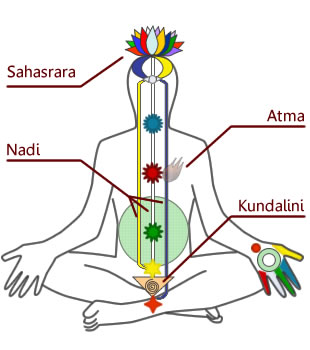
The terms Chakras, Nadis, Kundalini, Koshas and Prana (elan vital) are all from eastern philosophy and they all exists in the subtle body and not in our physical bodies as any molecular biologist knows that no such things exists in the physical body.

Nadis are not nerves but rather channels for the flow of consciousness. The literal meaning of nadi is "flow". Just as the negative and positive forces of electricity flow through complex circuits, in the same way, prana shako (vital force) and manas shako (mental force) flow through every part of our body via these nadis. According to the tantras there are 72,000 or more such channels or networks through which the stimuli flow like an electric current from one point to another.

Where is the evidence for the subtle body?

Another meaning of Kriya is an outward physical manifestation of awakened kundalini, such as a spontaneous body movement related to Kundalini energy flow. O Kriya Shakti is "a power of thought" said to be greatly studied by yogis.

Many long term practitioners of Yoga including myself have experienced spontaneous body movements which are almost like seizures. For more information read What are Kundalini Kriyas?

Is it Psychosis or Transcendence?

The awakening of Kundalini is not a psycho-somatic syndrome as some of the Western Psychologists wants us to believe. Its a perfectly normal phenomena where spontaneous kriyas cleanse the knots in the nadis there by enabling the smooth flow of Prana in the subtle body which initiates a man into the spiritual path of Yoga and redemption.


Where the chakras are mentioned in Aryan texts?

The chakras are mentioned in the famous Lalitha Sahasranamam Strotram which is chanted by Aryans.


Sahasrara 

Sahasraram bujarudha sudhasarabhi varshini. (Verse 109, LS)

Sahasraram bujarudha: Who then ascends to the Thousand – petalled Lotus known as the Sahasrara.
Sudhasarabhi varshini: Who sends streams of Nectar (spiritual bliss) from the Transcendent moon in the Sahasrara.


Agya 

Agya chakrantaralastha rudragranthi vibhedini. (Verse 107, LS)

Agya chakrantaralstha: Who next abides in the centre of the Agya – chakra.
Rudragrandthi vibhedini: Who finally breaks through the Rudra – granthi (the barrier to the subtlest dimension).


Anahatha

Anaha tabjanilaya shyamabha vadanadvaya. (Verse 100, LS)

Anaha tabjanilaya: Who is in the form of the Yogini called Rakini abiding in the Anahata Chakra.
Shyamabha: Who is of shining dark complexion.Vadanadvaya: Who as Rakini has two faces.


Vishudhi 

Vishuddhi chakranilaya raktavarna trilochana. (Verse 98, LS)

Vishuddhi chakranilaya: Who resides in the Vishuddhi Chakra.
Raktavarna: Who is of a rosy complexion like the Patali flower.
Trilochana: Who has three eyes.


Manipura 

Manipurantarudita vishnugranthi vibhedini. (Verse 102, LS)

Manipurantarudita: Who then emerges in the Manipura – chakra.
Vishnugranthi vibhedini: Who then breaks through the Vishnu – granthi (the barrier to still subtler dimensions).


Svadhisthana 

Svadhishthanam bujagata chaturvaktra manohara. (Verse 104, LS)

Svadhisthanam bujagata: Who abides in the Svadhisthana Chakra under the name of Kakini.
Chaturvaktra manohara: Who is fascinating with Her four faces.


Muladhara

 Muladharaika nilaya brahmagranthi vibhedini. (Verse 106, LS)

Muladharaika nilaya: Whose chief residence is the Muladhara.
Brahmagrandhi vibhedini: Who in Her ascent from the Muladhara breaks through the Brahma-grandhi (the Barrier of Brahma to the subtle dimension).


Lalitha Sahasranamam full song, just enjoy the melodious voice and its beautiful literary.

 
It is the south Indians who have a better grip on the Vedas and the Vedic chants than the North Indians.


Friday, 10 October 2014

Deity Yoga - Yidam Worship - Theurgy

The arrogant fools of the academic world and many ignorant believers and followers of eastern religions and western esotericism do not know that the gods of the pagans do exist literally and that one has to take their existence very seriously in order to completely understand their philosophical structure. I have been stating for a long time that there is an astonishing degree of similarities between Neoplatonism, Neoplatonic Christianity, Tibetan Buddhism and the historical Vedic religion and in relation to that these three terminologies Deity Yoga in the Vedic religion, Yidam worship in Tibetan Buddhism and Theurgy in Neoplatonism takes my argument to a much more solid level.

Deity Yoga

Yoga itself is a religion, its neither a set of philosophies or a set of stretchy exercises instead it is a set of rituals to achieve union with the pagan deities. 


At each and every step of sun salutations we utter magical spells to pagan gods silently in the mind.

1 ॐ मित्राय नमः om mitrāya namaḥ
2 ॐ रवये नमः om ravaye namaḥ
3 ॐ सूर्याय नमः om sūryāya namaḥ
4 ॐ भानवे नमः om bhānave namaḥ
5 ॐ खगाय नमः om khagāya namaḥ
6 ॐ पूष्णे नमः om pūṣṇe namaḥ
7 ॐ हिरण्यगर्भाय नमः om hiraṇya garbhāya namaḥ
8 ॐ मरीचये नमः om marīcaye namaḥ
9 ॐ आदित्याय नमः om ādityāya namaḥ
10 ॐ सवित्रे नमः om savitre namaḥ
11 ॐ अर्काय नमः om arkāya namaḥ
12 ॐ भास्कराय नमः om bhāskarāya namaḥ
13 ॐ श्रीसवितृसूर्यनारायणाय नमः om śrīsavitṛsūryanārāyaṇāya namaḥ

This generates a great efficacy in the transformation of our subtle bodies, nadis, pranic flow currents and chakras and pleases the pagan deities existing inside our subtle bodies who aid us in our spiritual enlightenment and in this way we attain the knowledge and wisdom of all the secret mysteries of the cosmos and gain mastery over nature and not become its slaves.

Yidam worship

Most secular Buddhists like Stephen Batchelor and Sam Harris and followers of Theravada Buddhism are not aware of the fact there are deities in Buddhism which exist literally and are not just symbolic or mere creations of the human mind. The modern world blurred by the scientific attitude looks so stupid in front of these traditions which possess ageless wisdom and truths about cosmos.


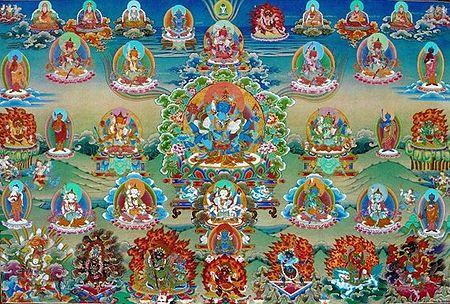
                         Hundred peaceful and wrathful deities of Tibetan Buddhism

What is Yidam practice?


Yidam (Tib. ཡི་དམ་, Wyl. yi dam; Skt. iṣṭadevatā) — one of the three roots, the tutelary or chosen meditation deity, which is the root of spiritual accomplishment. Yidams are often classified according to whether they appear in peaceful and wrathful form. 

Sogyal Rinpoche writes:

"In Tibetan Buddhism practitioners will have a yidam, that is, a practice of a particular buddha or deity with which they have a strong karmic connection, which for them is an embodiment of the truth, and which they invoke as the heart of their practice. Since in their practice they have recognized the yidam as the natural radiance of the enlightened mind, they are able to view the appearances with this recognition, and let them arise as the deity."

What is the importance of Yidam practice?

Orgyen Tobgyal Rinpoche explains the importance of the yidam:

When we consider all the great masters of the Indian and Tibetan traditions, we find that in every case, their accomplishment came about through their practice of a yidam. They chose a deity and guarded that practice like their very life force, and on the basis of that complete commitment to the path of deity yoga, they practised the stage of generation, the stage of completion, and integrated these arriving at their final realisation of complete accomplishment and enlightenment.

But nowadays there are people who say, “Oh, what a lot of bother! Deities and mantra, I hate all that. I’m just going to meditate.” And they sit there, and close their eyes, and that’s what they call practice. They say, “I just want to do effortless meditation.” But as Dilgo Khyentse Rinpoche said, “Although there are people like that, I’ve not seen them gaining any sign of attainment.”

In one of the texts of Ratna Lingpa’s cycle of Vajrakilaya practice, there is a passage which recounts how on one occasion Yeshe Tsogyal asked Guru Rinpoche about the nature of kyérim practice. “Do we really need a yidam deity?”, she questioned. Guru Rinpoche replied, “If there is no yidam, where is the source of siddhis? Without siddhi, how could there be enlightenment?”

In fact, if we look at the great masters of the Indian and Tibetan traditions of Vajrayana practice, we find there is no-one who did not meditate upon a yidam deity.

In the Nyingmapa school, all the great vidyadharas have had a main yidam deity which they practised. If their practice was of a peaceful deity, it was almost always Vajrasattva. If it was a wrathful deity, it was almost always Vajrakilaya. Guru Rinpoche and Vimalamitra themselves attested to the fact that Vajrakilaya was their yidam deity.

Nowadays however, the Nyingmapas are perhaps the worst when it comes to practising a yidam on a daily basis. When Jamyang Khyentse Chökyi Lodrö was giving the Rinchen Terdzö empowerment, he scolded us as Nyingmapa practitioners and said, “You Nyingmapas don’t do any kind of regular daily practice. You don’t even say the Sampa Lhundrupma prayer; you just lie around all day! We Sakyapas must do the path empowerment practice of Hevajra every day , which takes about two or three hours. You don’t do anything. You just lie around. You don’t do any kind of regular practice.”

He said to us, “If you want yidam deities, you Nyingmapas have more than anybody.” He showed us all the texts of the Rinchen Terdzö, which consists of dozens and dozens of volumes, and said, “This is filled with sadhanas of the three roots—lama, yidam and dakini—but none of you practises any of them.”

What he said was true. Perhaps the reason is that so many of us in the Nyingma tradition place great emphasis on the Dzogchen tradition and its effortlessness. Often we make the mistake of just paying lip service to effortlessness, while really just being kind of lazy.

Look at someone like Kyabje Dilgo Khyentse Rinpoche. No-one would question that his realisation was higher than anyone’s, and yet day and night he would recite prayers and mantras and do his practice. And he was inseparable from Vimalamitra! Look at the kind of effort that he put into his practice. Then there are others who just don’t do very much of that at all. They just sit there with their mouths open.

On one occasion, I asked Dilgo Khyentse Rinpoche, “Is it necessary for someone with realization to recite prayers and mantras?” And he replied, “Someone who has that kind of realisation is like space. What harm could recitation possibly do to space?” And he continued, “To recite even a single mani mantra, or to recite the Vajra Guru mantra a few times, is only going to help. It’s not going to hurt, is it?”

I couldn't agree more with what Orgyen Tobgyal Rinpoche has said here. He is absolutely right when he said that the great accomplishments of Indian and Tibetan masters came only from the worship of a pagan deity. A typical example is Ramakrishna Paramahamsa who was the teacher of Swami Vivekananda and all his accomplishments came only after he obtained the grace of goddess mother Kali. All the modern practitioners blinded by the stupid scientific attitude ignore the pagan gods and blindly go after knowing Brhaman and Nirvana and as you can see despite all their efforts for over a century or so they fail to produce a single mastery over nature or also called as siddhis. Why? its mainly because they follow the path of emptiness and they do not worship the pagan gods because for many westerners it is an embarrassment to worship pagan deities because it would undermine their stupid spiritual but not religious life.

No wonder why many of the extraordinary supernatural powers that can be performed by following eastern mystical practices are rarely demonstrated nowadays.

Eight primary siddhis

In Hinduism eight siddhis (Ashta Siddhi) are known:
  • Aṇimā: reducing one's body even to the size of an atom
  • Mahima: expanding one's body to an infinitely large size
  • Garima: becoming infinitely heavy
  • Laghima: becoming almost weightless
  • Prāpti: having unrestricted access to all places
  • Prākāmya: realizing whatever one desires
  • Iṣṭva: possessing absolute lordship
  • Vaśtva: the power to subjugate all

Bhagavata Purana

Five siddhis of yoga and meditation

In the Bhagavata Purana, the five siddhis of yoga and meditation are:
  1. tri-kāla-jñatvam: knowing the past, present and future
  2. advandvam: tolerance of heat, cold and other dualities
  3. para citta ādi abhijñatā: knowing the minds of others and so on
  4. agni arka ambu viṣa ādīnām pratiṣṭambhaḥ: checking the influence of fire, sun, water, poison, and so on
  5. aparājayah: remaining unconquered by others

Ten secondary siddhis

In the Bhagavata Purana, Lord Krishna describes the ten secondary siddhis as:
  • anūrmi-mattvam: Being undisturbed by hunger, thirst, and other bodily appetites
  • dūra-śravaṇa: Hearing things far away
  • dūra-darśanam: Seeing things far away
  • manaḥ-javah: Moving the body wherever thought goes (teleportation/astral projection)
  • kāma-rūpam: Assuming any form desired
  • para-kāya praveśanam: Entering the bodies of others
  • sva-chanda mṛtyuh: Dying when one desires
  • devānām saha krīḍā anudarśanam: Witnessing and participating in the pastimes of the gods
  • yathā sańkalpa saḿsiddhiḥ: Perfect accomplishment of one's determination
  • ājñā apratihatā gatiḥ: Orders or commands being unimpeded

Samkhya

In the Samkhya Karika and Tattva Samasa there are references to the attainment of eight siddhis by which one becomes free of the pain of ignorance, one gains knowledge, and experiences bliss. The eight siddhis hinted at by Kapila in the Tattvasamasa are as explained in verse 51 of Samkhyakarika:
  1. Uuha: based on the samskaras of previous births, the attainment of knowledge about the twenty-four Tatwas gained by examining the determinable and the indeterminable conscious and the non-conscious constituents of creation,
  2. Shabad: knowledge gained by associating with an enlightened person (Guru – upadesh),
  3. Addhyyan: knowledge gained through study of the Vedas and other standard ancillary texts,
  4. Suhritprapti: knowledge gained from a kind-hearted person, while engaged in the spread of knowledge
  5. Daan: knowledge gained regardless of one’s own needs while attending to the requirements of those engaged in the search of the highest truth,
  6. Aadhyaatmik dukkh-haan: freedom from pain, disappointment, etc. that may arise due to lack of spiritual, metaphysical, mystic knowledge and experience,
  7. Aadhibhautik dukkh-haan: freedom from pain etc. arising from possessing and being attached to various materialistic gains,
  8. Aadhidaivik dukkh-haan: freedom from pain etc. caused by fate or due to reliance on fate.

In Yidam practice one surrenders his individuality and attains oneness with the deity as explained below in Advice on Yidam practice.
“I am the great and glorious Heruka!
My food is the life-force of living beings,
My seat, the three worlds and three planes of existence.
I am the Lama. I am the Yidam.
I am Samantabhadra, the mighty Vajradhāra.
Without me, in the time before me,
There was no saṃsāra, no transcendence.
Now, the phenomena of saṃsāra and nirvāṇa
Are all perfect within me, the great Heruka.
The blazing fire mountain is my realm.
The vīras and ḍākinīs are my retinue.
The Great Perfection is my Dharma.
I am the Heruka of equalness and perfection.”
At all times, such pride is necessary.

By Shenphenpa (Khenpo Shenga).
Translated by Adam Pearcey, Rigpa Translations, 2013.

Theurgy

Theurgy (/ˈθiːɜrdʒi/; from Greek θεουργία) describes the practice of rituals, sometimes seen as magical in nature, performed with the intention of invoking the action or evoking the presence of one or more gods, especially with the goal of uniting with the divine, achieving henosis, and perfecting oneself.

The great divine Iamblichus, Proclus and Julian the Emperor gave a great deal of emphasis to theurgy in Neoplatonism which the academic scholars still see it with contempt eyes without understanding the supra-rational character of the art of theurgy.

Proclus (c. 480): theurgy is "a power higher than all human wisdom embracing the blessings of divination, the purifying powers of initiation and in a word all the operations of divine possession"
 Julian the Emperor said in his Hymn to King Helios that no one knows about the subject more better than the Neo-platonic philosopher the divine Iamblichus.

The Emperor Julian the Apostate (332-363), embraced Neoplatonic philosophy and worked to replace Christianity with a version of Neoplatonic paganism. Because of his death and the hold mainstream Christianity had over the empire at the time, this was ultimately unsuccessful, but he did produce several works of philosophy and theology, including a popular hymn to the sun. In his theology, Helios, the sun, was the ideal example of the perfection of the gods and light, a symbol of divine emanation. He also held the mother goddess Cybele in high esteem.

Julian favored ritual theurgy, with an emphasis on sacrifice and prayer. He was heavily influenced by the ideas of Iamblichus.
I want to fulfil the dream of Julian, his great desire to revive the pagan mystery religions back to the roman empire which for unfortunate reasons failed to succeed after his reign.

"By magical incantation rapid rivers may be made to run back to their fountains, the sea be congealed, winds become destitute of spirit, the sun be held back in his course, the moon be forced to scatter her foam, the stars be torn from their orbits, the day be taken away, and the night be detained."
- Iamblichus on the mysteries of Egyptians, Chaldeans and Assyrians.
"Theurgic union is attained only by the perfective operation of unspeakable acts correctly performed, acts which are beyond all understanding, and by the power of unutterable symbols which are intelligible only to the Gods"

Iamblichus, De Mysteriis. 2,11
Offering to the Gods: A Neo-platonic perspective by Edward P Butler is a fine study on the subject and demonstrates the wisdom and knowledge that the great divine Iamblichus had on the subject.

Conclusion

As the reader can see these set of pagan ideas are at the core of pagan philosophy and their attitude towards nature and religion. All the pagan religions have a certain affinity towards the art of theurgy and in eastern religions it was called by different names that's all but the theory and the practice remains absolutely identical. I urge scholars, practitioners and believers around the world to not to distort eastern mysticism and western esotericism and undermine the existence of pagan gods and their culture and philosophy.

Saturday, 5 July 2014

What half-witted American practitioners and marketers need to know about Yoga.

What is Yoga?
       
                            संयोगो योग इत्युक्तो जीवात्मपरमात्मनोः॥
                           saṁyogo yoga ityukto jīvātma-paramātmanoḥ॥
             Union of the self (jivātma) with the Divine (paramātma) is said to be yoga.
                                  —Yoga Yajnavalkya

This is the most ancient definition of Yoga according to the Vedas. Jivatma means the individual soul and Paramatma means the Sun God Surya (Sun Salutations remember!). So the practice of trying to union the individual soul with God is Yoga. See how I use the same Sun Salutations (How to worship the Sun God) which you guys call as stretching to obtain my redemption which is very much different from the redemption of orthodox Christianity.

Yoga in later Hinduism
I instructed this imperishable science of yoga to the sun-god, Vivasvan, and Vivasvan instructed it to Manu, the father of mankind, and Manu in turn instructed it to Iksvaku. The supreme science was thus received through the chain of disciplic succession, and the saintly kings understood it in that way. But in course of time the succession was broken, and therefore the science as it is appears to be lost.” 
- Bhagavad Gita 4.1 & 4.2
 Who has the Authority to practise Yoga? 
“Arjuna, one who practises yogabhyasa following yama and niyama is a superior atma to those who are tapasvi, gnani and those who practise nitya naimitya kaamya karma etc. Hence you should follow the yama and niyama and conquer your mind and become a yogi.” 
Thus advised Sri Krishna paramatma, extolling the virtues of yogabhyasa, and from this it is clear that yoga gives very superior benefits. Everyone has a right to do yoga. Everyone — brahmin, kshatriya, vaishya, sudra, gnani, strong, women, men, young, the old and very old, the sick, the weak, boys, girls, etcetera, all are entitled to yogabhyasa with no restrictions on age or caste. This is because yogabhyasa rapidly gives maximum visible benefits to all. It does not stop anybody from acquiring the visible results of practice, whatever their capabilities. Everyone is entitled, irrespective of caste, to follow the path of yogabhyasa even in order to obtain divine virtues and the resulting eight animadi siddhis, and, if one ignores these siddhis, to proceed further on the ultimate path. But many do not agree with this opinion. This only reveals their confusion and the absence of a sattvic state of mind. (The sastras do not forbid yoga for anyone.) Whoever wishes to do yoga has the right to do it. Yet whoever it is, it is very important that they should only learn all the aspects and practise it under the guidance of a proper guru. One encounters obstacles and problems if yoga is practised without a guru. 
But “Ruffians, those who eat wrong food, talk filth or use abusive language, those who speak ill of others, lie about others, are obsessed with food, those who are addicted to sensual pleasures, those who pretend to be good, those who destroy and cheat, carry aversion in the mind, those who are disrespectful of the vedas, are alcoholics, or have any such bad habits, these people, no matter what caste or religion, are not fit to practise yoga.” This is firmly stated by Gherandacarya. 
The reason for this is that although these people are capable of practising yoga, these practitioners with their cunning could cause problems and injuries to others in spite of the yogabhyasa being “pure”. There have been many examples to substantiate this in the puranas and in our experience. For example, everybody knows that pure cow’s milk gives good health and happiness. Yet if it is poured in a cup made of pig’s skin or dog’s skin, it turns into poison and becomes harmful. Similarly if you teach the pure divine nectar of yoga to ruffians and cheats, it will only cause disaster. Like a king who entrusts his kingdom to a no-good useless son who destroys it instead of protecting it, a guru with good intentions may teach yoga to cheats and the latter will not know how to use it properly and will cause only destruction to the world. 
Those who are eager to learn good skills, those who can learn to control their senses and are peaceful by nature, those who speak the truth, who wish to serve their guru, who are devoted to their mother and father, who do karma according to the sastra, who are clean, who love bathing in the Ganga, who follow their caste dharma, who are modest and patriotic, who have pride in their family, all these people are good vessels for yoga. If the guru, following the correct path and method, advises such people and makes them practise in front of him, they will quickly become adept. The readers should remember this very well. You will not become a skilled yogi just by putting on the costume and faking it. Whatever occupation you are engaged in, you have to be very serious and strict and dedicated and at least follow the proper standards and restraints. Those who do not fall under the previous categories do not have the right to practise yoga.

Its quiet clear that American Yoga practitioners don't respect the Vedas at all and hence they do not have the authority to practice Yoga. Neither they lead an ascetic life as it is required in the Yoga guidelines nor do they lead a spiritual life. If you want to practice Yoga you have to respect the Vedas and the Vedic deities in them otherwise you have got no authority to practice it. Yoga belongs to no one it belongs to the Sun God and if you don't even give a prayer of thanks to him that just speaks your hearts. I know as Christians you cannot pray the pagan Sun God then please acknowledge that it is pagan ritual and go to a gym instead, but please don't make me do this, don't make me mock at you guys for all the stupid things you do in the name of yoga which is a very sensitive religious practice for us.

As a follower of King Helios I have to do sun salutations in the morning as well as in the evening but I have left doing it for quite a few years because I know the kind of purity of mind and heart it takes to do such a ritual and its not something which should be taken lightly. Its a irony that what one country calls it stretching and falls into New Age nonsense, devil worship, witchcraft and other stuff instead of gaining good wisdom an another country reveres the same stretching exercise as the most auspicious and sacred redemption ritual ever.

I warn both Indian and Western marketers to not sell yoga like a brand product, I know you all practice yoga to make up for your crappy lives rather than to gain wisdom and gnosis so go to a gym instead, yoga is not the answer for your crappy lives, it is meant for something more than this world.

Don't test our patience we will no longer tolerate it anymore.  

Sunday, 18 August 2013

Should Christians practice Yoga?

No, its blasphemy. Christians shouldn't perform yoga. The American Institute of Vedic studies by David Frawley is quite determined to bring out the misconceptions that many of them have on Hinduism and Yoga.


Hiranyagarbha and Vedic Yoga 
Who then was Hiranyagarbha, a human figure or a deity? The name Hiranyagarbha, which means “the gold embryo”, first occurs prominently as a Vedic deity, generally a form of the Sun God. There is a special Sukta or hymn to Hiranyagarbha in the Rig VedaX.121, which is commonly chanted by Hindus today. The Mahabharata speaks of Hiranyagarbha as he who is lauded in the Vedic verses and taught in the Yoga Shastra (Shanti Parva 339.69). As a form of the Sun God, Hiranyagarbha can be related to other such Sun Gods like Savitri, to whom the famous Gayatri mantra is addressed. Therefore, the Hiranyagabha Yoga tradition is a strongly Vedic tradition. We can call it the Hiranyagarbha Vedic Yoga tradition. 
Krishna states in the Bhagavad Gita (IV.1-3) that he taught the original Yoga to Visvasvan, another name of the Sun God, suggesting Hiranyagarbha. Vivasvan taught this Yoga to Manu, the original man or first king, making it into the prime Yoga path for all humanity.
As it clearly states Yoga is owned by the Sun God, it is no ones intellectual property. It was he who gave the knowledge of yoga to the world and yet the world is totally ignorant of this and gives no homage to him. (Hindu Group Stirs a Debate Over Yoga’s Soul - New York Times)

What most westerners don't understand is that it is impossible to separate the Vedic deities from the practice of Yoga. Vedic deities are anthropomorphic gods with whom we can have a dialogue with, they are real beings and they reside in our bodies, this is the traditional view and we will not tolerate if a false interpretation of our scriptures is promoted all over the world.


All those Christians who practice yoga are already worshipping a different image of god. It is wrong as many of the bishops blindly say that Yoga is the work of the devil (Yoga is the work of the devil says Vaticans chief exorcist) without being aware of its origins and the traditions it come from and  it is equally wrong to impose Yoga on young Christian minds and try to bring down Christianity.

Christianity doesn't need any help from Hinduism, it is self sufficient, it has all the goods with in it. It has more hope than Hinduism. I'll be more than happy if Christians worship Christ rather than meddling with eastern religions.  

Wednesday, 23 May 2012

How to worship the Sun God?

This is one of the ways to worship the sun god which is easier and effective for the modern people who go through hectic working hours and for those who don't have time to sit and do meditation for long hours. Meditation never worked for me, you cannot do meditation and gain something in a busy area like New York, Tokyo or any other capital cities and hence people travel to Himalayas to lose all contacts from the people around them to find a lonely and a silent place for personal investigation.

There is no need to travel anywhere to know god giving up your loved one's, god is personal and he will reveal himself to you where ever you are if you're preparing yourself to see him. Many people in the west and across the world perform yoga just for the sake of keeping their body fit and healthy but they don't realize that these are the same methods which was used by the sages of ancient traditions to have revelations about god, they were gnostic theists, they believed that the absolute truth or god can be known.


One has to pray the following verse in the begining of the method.

hiranmayena patrena satyasyapihitam mukham
tat tvam pushannya apavrino satya-dharmaya drishtaye

Isha Upanishad, Verse 15 from the scripture

It means that the truth is hidden behind God's pleroma of light rays and those light rays are preventing us from seeing him clearly and the ultimate truth, so we should plead him to remove those impeding light rays and show us the path of righteousness

SURYANAMASKAR

* Om Hraam Mitraya Namaha (Mitra - friend)


1. Stand facing the Sun with palms folded and both the thumbs touching the chest.

Breathing: Inhale while raising the hands and exhale as hands are brought down to chest level.


* Om Hreem Ravaye Namaha (Ravi - radiance)


2. Raise hands upward, with feet firmly on the ground, bend backwards, stretch arms fully.

Breathing: Inhale


* Om Hruum Suryaya Namaha (Surya dispeller of darkness)


3. Slowly bend forward, hands touching the earth with respect, head touching the knees.

Breathing: Exhale.


* Om Hraim Bhanave Namaha (Bhanu Shining with luster)


4. Set both hands with the palms down firmly on the ground, pull the left leg backward, raise the head looking at the Sun, full weight resting on the two palm and ten fingers.

Breathing: Inhale


* Om Hroum Khagaya Namaha (Khaga all pervading)


5. Bring right leg back close to left leg, keeping hands and legs straight, bend the body at the hip forming an arch, just like a mountain, known as 'parvathasan or mountain pose'.

Breathing: Exhale


* Om Hraha Pooshne Namaha (Pushan mystic fire which gives)


6. Stretch yourself fully on the ground in the Saashtanga Namaskar pose (all eight 'anga' or parts of the body on the ground head, thigh, eyes (sight), mind, word, feet, hands and ears (hearing)). In reality, feet, knees, thighs, chest, forehead touch the ground with the hands stretched out and in folded position, with your mind and thoughts on the full namaskar, then slowly turn the head to the sides first to left and then to right so that each ear touches the ground.

                                                        Breathing: Inhale first and then Exhale fully.

* Om Hraam Hiranyagarbhaya Namaha (hiranyagarbha golden colored)


7. Slowly raise the head, bend backward as much as possible, hands straight, in the cobra pose.

Breathing: Inhale


* Om Hreem Marichaye Namaha (Marichi Ray of light)


8. Parvathasan same as Step 5.

Breathing: Exhale


* Om Hruum Adityaya Namaha (Aditya Sun, aspect of Vishnu, Son of Aditi.)


9. Same as Step 4 with the difference that the right leg is brought forward.

Breathing: Inhale


* Om Hraim Savitre Namaha (Savitru Light of enlightenment.)


10. Same as Step 3

Breathing: Exhale


* Om Hroum Arkaya Namaha (Arkah a ray of light, a flash of lightning, Sun)


11. Same as Step 2

 Breathing: Inhale


* Om Hraha Bhaskaraya Namaha (Bhaskara Shining Light)


12. Same as Step 1

 Breathing: Exhale, Inhale and Exhale.


( Caution: This exercise has to be performed under the guidance of a master I am not responsible for any side effects on your body if you do not do it correctly and approach it with egoistic mind and the verses given in asterisk should be silently uttered in mind while one is performing the exercise and this has to be performed two times in a day morning and evening)