Showing posts with label Gnosticism. Show all posts

Tuesday, 23 October 2018

Jesus suffered on the cross but not Christ

As a Valentinian Gnostic I do not believe that Christ was crucified and suffered on the cross. Christ was not only before Abraham in fact he was before the time of Jehovah or Yahweh, the god of the Jews. Christ requested Achamoth to bring forth Jehovah and she maneuvered him to create the heavens and the earth which was modeled according to the Pleroma above. Achamoth who was cast out of the Pleroma was saved by Christ and out of joy she emanated weak spiritual seeds and these seeds required a place for them to become mature to finally enter the Pleroma. Earth was that chosen place.

If Christ wanted us to believe and worship him as a historical person then he would have left us blueprints of his existence through out his life but as the facts show he left no relics of his existence. The shroud of Turin is a fake from the 13th century. All this shows is that Christ did not wanted us to blindly believe in bodily resurrection and hope one day that you would be saved. I still haven't seen anyone physically rise from the dead. As a Valentinian I do not believe in bodily resurrection. 

Matter and Spiritual substances do not mix and they are completely different from one another. It makes no sense for Christ who was spiritual in make to suffer like an ordinary human being engulfed in matter. Christ entered the body of Jesus at the time of his baptism and flew out of his body before the crucifixion and the flogging. The psychic Jesus having a material body was sent by Jehovah and the pneumatic Christ possessing a spiritual body was sent by the unknowable Holy Father in the Pleroma.

Sorry Irenaeus, yes we Valentinians do divide Jesus Christ and its for a valid reason and it makes perfect sense rather than wasting our lives by blindly believing in the resurrection of the dead and falsely hoping that you will be saved one day. I wish our salvation was this easy but definitely its not unless you receive the gnosis of the Father from Christ.

Saturday, 20 October 2018

The world-view of a mystic or a gnostic

While scientists all over the world are busy working on to understand quantum entanglement, quantum gravity and the space-time continuum, we mystics or gnostics on the other hand have a problem of our own. According to the doctrine of Emanationism this whole cosmos was originated from the womb of a supreme anthropomorphic God.

How on earth can we reconcile this view with the vast number of distances known to exist between galaxies and our solar system? I always stress and use the word anthropomorphic because God is a person just like you and me. God is personal and you can converse with him.

The Gnostic view of Pleroma cannot be reconciled with the scientific empirical view and that's why statements like this: "What we call empirical reality is only a state of mind" by Bernard D'Espagnat, theoretical physicist, are very appealing to me. We have no other way other than to deny the whole of science and this empirical reality to accommodate the gnostic view of Pleroma in this modern age and time.

I am a Valentinian gnostic and I know that the Pleroma exists which implies this visible cosmos which we call as Kenoma was modeled from it. The problem is not that we have to update our classical notions of space-time in fact the problem lies more in our epistemology or ways of knowing things the way they are (or ontology). Physicists are still not settled in answering whether space is continuous, quantized or a 2d hologram. They have compiled a list of point particles that govern this cosmos which they call as the Standard Model but I am gonna ask the same question which Stephen Hawking asked, Is that a true understanding of the cosmos? I would say no, because according to the mystery religions space and time are anthropomorphic Aeons and without a true understanding of them its not possible to understand how they manifest in our visible Kenoma world.

Each one of the Aeons and including us (homo sapiens) is a Pleroma by itself. Just like a single cell has all the information with in it to encode a full human being (I mean regulation of gene expression in the words of molecular biology) similarly we have the full potential with in us to create an another universe. 

"If you have seen the Father in the real realm you will become the Father" - Gospel of Philip

The Holy Father emanated the Aeons and multiplied himself and entered into these Aeons. The cosmos is nothing but a manifestation of these Aeons which implies the Holy Father is everywhere and in everything. The cosmos is nothing but a playground for the Holy Father. How does this multiplicity of individual souls transforms back again to a unified world soul is one big mystery which the Father alone knows. Anything beyond this is ineffable.

Friday, 6 April 2018

Evil is an emergent property of the cosmos

God did not intend to create evil. It was not in his mind to make us suffer in this world. God held our perfection with in himself when he created the cosmos and wanted to give back the perfection to us when we returned to him out of love. This ignorance of the Father (imperfection) gave rise to evil and suffering in this world which was an emergent property of system due to the design choice made by God. The origin of evil was in a way inevitable.

People started hurting others and participated in sinful acts because they had no knowledge of from whither they have come and whither they are going. This is the state of affairs in the world as we know it from the Gospel of Truth. Now what do we do? How can we proclaim our perfection back? How can we get back our lost identity? Well, the fact of the matter is God did not gave us free will, you might do lots of charity, help the poor and the diseased, feed hungry people and do all kinds of good things and yet there is no guarantee that God will save you and send you to heaven. You might still end up in hell even after leading a righteous pure life. Why? It is because God saves you not based on works of the Law but based on unmerited grace. He saves us because he loves us, period. Nothing less nothing more.

Rather than saying God's grace is arbitrary you need to the see the world from the viewpoint of God. The truth is we are all souls with each one having the full potential within us to become the Holy Father, we are the Holy spirit, that's our true identity. Once you know this you cannot hate God for what he has in store for us. He(God) can do anything with yourself and with this world because none of the things in this world are yours, it is his body and his world and he has full authority over it, one of the reason why the Gospel of John says do not love this world nor the things in this world, the lust of the eyes and the prideful way of life is not from the Father but is from the world, the world is a passing by but one who does the will of the father will live forever or will obtain immortality.

You cannot bribe God's grace by trying to please him by doing good deeds, you cannot earn God's grace no matter what you do, there is no way through which you can earn God's grace, the grace from God should come to you all by itself. The only way now for us is to love the Father unconditionally (because that's what he wants from us) and not turn away from him or blame him when he gives us hardships instead see those difficult times as a testing period and hope that one day he will release our soul from this world and gives back our true identity which we all deserve.


Saturday, 1 October 2016

Does God allow evil to exist in the world?

If God is omni-benevolent then he must not allow evil to exist in the world. How did evil came into existence in the first place? As it is said in the Gospel of Truth when God emanated 30 odd Aeons and created the Pleroma he held their perfection with in himself and kept all of them in ignorance and did not gave them the Gnosis of the Father which they all were lacking. It was at this point that ignorance entered the world, it was at this point sin entered the world, it was at this point evil entered the world. Good and Evil, Gnosis and Ignorance, Sin and Righteousness are mutually exclusive if one exist then the other disappears into non-existence.

Why did God held the perfection of the Aeons with in himself which in turn led evil to enter the world? Think about it in the other way around if God had given the perfection to the Aeons and if all the Aeons had the knowledge of the unknowable Father then Sophia wouldn't have to search for the unknowable Father, she didn't had to err in her passion to know the Father and the Father did not had to cast her non-spiritual elements which emanated in the form of Achamoth outside the Pleroma. Jesus did not had to descend from the above Pleroma to save Achamoth and Achamoth did not had to emanate the immature spiritual seeds out of happiness while seeing Jesus descend from the above Pleroma and without the immature spiritual seeds Jesus need not had to request Achamoth to bring forth the Demiurge Jehovah, the God of the Jews to create the heavens and the earth and create Adam and Eve in the image of the above Pleroma for the spiritual seeds to grow and become mature.  

As you can see we wouldn't have existed if God had given the perfection to the Aeons. All the above course of events would not have taken place if God had given the knowledge of himself to the Aeons. He deliberately held back their perfection within himself. Why did he do like that? According to Gospel of Truth God held back their perfection because he expected them to love him back and wanted the Aeons to return to him out of love to receive his gnosis in return. We often notice that if we get something very easily we don't get to realize its true value its only when we earn something out of hard work we will realize the true worth of something or someone. Even parents don't buy whatever their kids ask without making them realize the fact that life is a difficult road to drive in. In the same way God held the perfection of the Aeons with in himself in order to make us know his true value and the true worth of his gnosis otherwise if the gnosis of the Father could be easily bought for a few penny then no one would have given respect to the Holy Father.

Okay, God created this world in the hope that the beings in it would love him back and return to him but hang on a second on one hand he expects us to love him back and on the other hand he has held back our free will without allowing us to make a choice for ourselves. How does God decide whom to give gnosis and whom to keep in ignorance? Is God's grace arbitrary? By keeping us ignorant of him and there by holding back our perfection which belongs to us is he allowing evil to exist in the world? If he really wants us to love him back he could have really wiped out the evil archons of the world who is keeping humanity in ignorance and stimulate our minds to love him back.

It seems God is in a dilemma here if he gives our perfection too early there is a danger that the fruit of gnosis may rot due to our immaturity and if he delays it he will be responsible for allowing evil in the world. The advice from the Gospel of Truth is to not to take evil too seriously and not to weep for all the evil done by the archons of the world but instead we must prepare ourselves to return to the Pleroma and wait for our time to receive the gnosis of the Father.

Tuesday, 19 July 2016

Catholicism was constructed as a defense against Marcion


What a load of shitty speculation right over there! The claim that Marcion and his followers namely the marcionites wrote the Pauline corpus is very absurd. Marcion was the man who believed that only Paul understood the true message of Christ and rejected the Old Testament and its Jewish god Jehovah completely. So for Marcion, a ship owner of Pontus to convert and arrive at the conclusion of Marcionism the Pauline Epistles must already have been in existence for him to get influenced by Paul and his teachings. Robert Price knows that this version of his view is actually a chicken and the egg problem. Marcion wrote the Pauline letters but for Marcion to get influenced in order to write the Pauline letters the Pauline corpus must have been in existent before Marcion became active.

To tackle this problem he makes an even more absurd claim that Simon Magus was actually Saint Paul of Tarsus. We cannot rely on the information of Simonism from Irenaeus because in a hurry to refute the heretics he took whatever sources that was available to him without checking there credibility and therefore his works are very unreliable. In fact the Gnostic systems which he attributed to Valentinus was not the actual system which Valentinus himself believed in instead his accusations were directed to the later modified systems of Valentinian followers like Heracleon and Ptolemy. So are the clementine homilies which cannot be trusted.

Secondly, one of the other argument of Robert Price is that there are contradictions with in the Pauline Corpus for example comparing Corinthians and Galatians where Paul says that he received his wisdom of Christ while talking with the elders of Jerusalem and on the other hand in Galatians he says that his teachings were mainly derived from his personal revelations of divine and not taught by any human or angel. Robert Price thinks that such contradictions shouldn't be there in a corpus if it was claimed to be written by only one man so he concludes that Marcion wrote Galatians.

What I believe is that instead of Marcion writing Galatians it is more likely that the sentinels of the Catholic church edited Corinthians to make it appear more mainstream and made it leaning towards their own dogmatic beliefs. Suppressing the truth that the relationship between Paul and the church at Jeruasalem was not smooth and suppressing the portrayal of a zeolot anti-Semitic Paul who used to accuse them straight on their faces.

The last idea of Paul being Simon Magus is ridiculous because:

  • Paul was a tent maker while Simon was a sorcerer.
  • Paul was born and brought up in Tarsus while Simon was from Gitta, a village in Samaria.
  • Paul loved the Gentiles and his mission was directed towards the Gentiles but we have no evidence to prove that Simon had any interests in converting and persuading the Gentiles to the ministry of Jesus. Paul's division of teaching one thing to the Jews and another to the Gentiles appears as early as in Romans.
  • Paul displayed sensitivity towards a wide range of complex issues but Simon lacked any such sensitivity.
  • It was Saul who was under the tutelage of the great Gamaliel and not Simon.
  • It was Saul who was struck blind fold on his road to Damascus and not Simon.
  • It was Paul who held a Roman citizenship and could fluently read and write Greek and not Simon.
Marcion may have indeed been the first person to collect the different Pauline letters and showed the value of them to the world and his polemic indeed triggered his rivals to establish a different canon of their own by editing and adding verses and by forging new Gospels in the name of Paul which suited to their own agendas. Well if not Marcion I am damn sure Valentinians would have collected and compiled the Pauline Corpus irrespective of whether Marcion collected it or not because no one on earth loved Paul so much other than the Valentinians. Even the Gospel of John has gone through a series of successive editions before making it to the biblical canon of the Catholics because there are many verses in them which are offensive to the Gnostics and equally there are anti-Semitic verses in it which goes to the extreme supporting Gnosticism in full force. All this shows that the New Testament as we have today is not the same version as people saw it two thousand years ago.

The real historical Paul was never really like the Paul of the Catholics as we know today. He was a zealot anti-Semite and more of a Valentinian than a Catholic.

Sunday, 3 July 2016

I want to serve Christ for the rest of my life

I don't think I would have been alive if I had not acquainted with Valentinianism. Christ, the Savior not only saved me in fact he raised me above everyone else in this world. All my sorrows go away whenever I read the first line of Gospel of Truth, it brings a smile on my face every time I read, "Gospel of Truth is a joy to those who have received from the Father of Truth the gift of knowing him." it is indeed a joy, a good news because we know it is a message of hope sent by our Father to the pneumatics.

I encountered Gnosticism at the age of 16 while watching the Gospel of Judas series hosted by the National Geographic Channel casting Meyer Marvin, Elaine Pagels and others. I did not concentrated too much on Gnosticism after that because I didn't had a clear picture at that time. I used to read articles on Gnosticism here and there but none of them caught my attention very much. It was only after studying Valentinianism that I began to see a complete picture and built my confidence and faith in Gnosticism. After knowing that Valentinus, the leader of Valentinianism, was an adherent disciple of Saint Paul of Tarsus and loved Gospel of John my faith in that tradition increased even more.

I completely believe in the mythology and cosmogony of the Valentinians with the only change being they didn't gave a name to their Holy Father but I do give their Father a name, its Helios-Mithras. The ontology of their Holy Father is none other than the ontology of Helios-Mithras.

Christ showed me the way, he healed me, he showed me why this world is full of evil and why people behave the way they do. He made me a Pagan Gnostic Christian and brought me alive:

"Do not love the world or anything in the world. If anyone loves the world, the love of the Father is not in him. For all that is in the world—the desires of the flesh, the desires of the eyes, and the pride of life—is not from the Father but from the world. The world is passing away along with its desires, but whoever does the will of God remains forever." (Gospel of John)

Sunday, 24 April 2016

As a Valentinian Gnostic I have no secrecy to maintain

My sheep listen to my voice; I know them, and they follow me. I give them eternal life, and they shall never perish; no one will snatch them out of my hand. My Father, who has given them to me, is greater than all; no one can snatch them out of my Father's hand. I and the Father are one."

- Gospel of  John (28-30)
Most people often assume that Gnosticism is full of about secrecy and mystery as works like these Mystery and Secrecy in the Nag Hammadi Collection and other Ancient Literature: Ideas and Practices and others show. Many Hindus and Pagans often keep powerful spells a secret without sharing it in public which is so stupid of them to do like that. People of such attitude have not really understood about gnosis at all. 

Gnosis for all practical purposes is a private affair and nothing in this world can stop anyone of you to attain that and once you have gnosis no one can snatch it from you. It can be attained just like you attain any other knowledge only difference being other knowledge are readily available everywhere but gnosis is only available from the grace of God.

Just by sharing your gnosis or powerful spells with others will not decrease the gnosis that you have and will not burn down your house and even if others use the powerful spells that you shared with them for evil purposes its no great deal let them do why should we be so afraid of evil when we have our Father who is greater than all through whom both good and evil has originated and when no one can snatch the gift of immortality from him.

People are yet to come to terms with the religions of the Mediterranean people, they wholeheartedly accepted that the world which they were living was full of evil and accepted the fact that God has let both good and evil to equally co-exist in this world but in the end the good always win over the evil. Rather than blaming anyone or God for the current situation of the world they mastered the nature surrounding them and started controlling the forces of nature like divine magicians capable of achieving anything or even capable of creating a all new universe. This was the attitude of the Mediterranean people, they were not afraid of evil and they were not afraid to travel across the various worlds and the heavens.

When evil is rising across the world and ruling it what's the point of keeping your gnosis with yourself without sharing it with others? Don't we realize that the only thing that's going to save humanity from evil is the gnosis of the Father and not anything else? Did Jesus Christ resurrected and preached the gnosis for us only to keep it for ourselves boasting and making others look inferior to us of how special we are compared to others? No, he preached gnosis to us because we were the elected ones it doesn't mean that he has not sown the spiritual seed on other non-elected ones its just that they are not prepared for it yet.

I am not a Brahmin by birth and if I go and ask them to teach me Vedas, Upanishads and Sanskrit they will not teach me because of two reasons one I am a non-vegetarian and two I was not born as a Brahmin. However not all Brahmins are like that there are other Brahmins who oppose this and believe that everyone should be initiated into the mysteries of the Vedas and one such person was Devudu Narasimha Shastry who initiated me into these mysteries through his discourses just like the divine Iamblichus used to initiate people like Julian the Emperor into Mithraism through his discourses confessed by Julian himself. We need people of such attitude more in this world and not selfishly enjoy the grace which God has given to you when the whole world is actually burning. Gods never love such people.

Wednesday, 23 December 2015

There's something wrong with the world

Morpheus: I know exactly what you mean. Let me tell you why you're here. You're here because you know something. What you know you can't explain, but you feel it. You've felt it your entire life, that there's something wrong with the world. You don't know what it is, but it's there, like a splinter in your mind, driving you mad. It is this feeling that has brought you to me. Do you know what I'm talking about?

The reason why I ended up as a Valentinian gnostic is because right from my teenage I have always felt that there's something wrong with the world. That's the basic premise in the origin of gnostic thought that there's something wrong with this world. This world was not created by the supreme God instead this world is just a shadow copy of the real things that exists in the Pleroma. Plato and Neo-Platonists were right. This world is not real and we are mere prisoners of the cave. The pagan mystery religions exist solely to return us to the source where we came from.

Thursday, 17 December 2015

Teaching Gnosticism in schools

I honestly had to wait for over 16 years of my life just to hear the word 'Gnostic' and 'Gnosticism' and that too I didn't hear it from one of my teachers or in any lesson of my school curriculum. I heard it while I was watching the National Geographic Channel who did a documentary on the lost gospels found in the Nag Hammadi library in the year 2006 Lost Gospel Revealed; Says Jesus Asked Judas to Betray Him and yes I was 16 years old then.

So if the NGC had not made a documentary I wouldn't have heard about the existence of the Gnostic sects of Christianity to this day or would have encountered that term at some point in time later in my life. It was from their documentary that I was introduced to people like Marvin Meyer and Elaine Pagels and the likes of others. As I was not aware of the big picture at that time the documentary was interesting to watch but I didn't do any further research on Gnosticism. 

This clearly shows that the history which is being spoon fed to us in schools is entirely a fabricated false history of the world suppressing those things which goes against the established order. I prefer to have truth over an corrupt established order based purely on lies. I prefer to have light than be in the darkness like a prisoner in the cave.

Why there is not even a single lesson on the Inquisition of the Catholics or even just a paragraph on the existence of the gnostic sects of Christianity? The stupid Indian school curriculum wants us to believe in the idiotic doctrine of Sarva Dhama Sama Bhava (All religions are equal) and that's why they don't include any material in the school curriculum which goes against that doctrine. They want to make us believe that all religions existed peacefully throughout our human history like the way India believes itself to exist now. Why not a chapter about the Multan Sun Temple in the History subject of the school curriculum? Let the kids know who did what and who is evil and who is good. The Indian minds are so stupid they never question what is being fed into them and they rarely try to know how they got here in the first place. While some good teachers do encourage students to cultivate individual independent thinking rarely do students take such an advice seriously.

Doesn't our kids deserve to know the true history of the world? What are the established systems so afraid of?


Saturday, 28 November 2015

My paper about Esotericism on Academia.edu

I don't believe in Intellectually property rights and neither did the Vedic rishis because all knowledge has come down to us from God and there is nothing for us to boast about.

There was no concept of intellectual property in the ancient world, and plagiarism was widely seen as a homage to the original author. The Stanford Encyclopedia claims "It must also be recognized that 'forgery' is a modern notion. Like Plotinus and the Cappadocian Fathers before him, Dionysius does not claim to be an innovator, but rather a communicator of a tradition."
However I would love to see my paper, Why the polytheistic mythos of the esotericists is inevitable?
published in an academic Eostericism journal but I seriously doubt anything like that even exists so I have uploaded a draft copy of my paper on Academia.edu so that at least others can benefit from my research and take it forward and review it.

Here is the updated draft copy.

Why the polytheistic mythos of the esotericists is inevitable?

Wednesday, 25 November 2015

Savitr the supreme lord of the cosmos

The proto Indo-Iranian religion started off as Sun Worship. 

 - Max Mueller

The tradition of Shukla Yajur Veda worships Savitr as Brahman and the Rishi of this tradition is the great sage Yajnavalkya who extolled the Sun God and received such fresh portions of the Vedas which was not known to anyone before. The famous Ishavasya Upanishad is from this tradition which contains with in itself the ultimate truth of the universe and a pathway to know Brahman.

The Sun God will be very pleased if one gives up Sankalpa and does unselfish holistic worship to him. The greatest mystery which is so astonishing is the truth that all other gods exists in his womb and form his body, this is the reason why he is called as Hiranyagarbha, the golden egg, (garbha means womb or egg). Each individual light ray emanating from his body is an individual god, this is baffling and one can experience it by sincere devotion and worship to him.  Scientists and atheists are ignorant of this and they are taking the world in the wrong direction. For those who have not gone through upanayana rituals like me i.e. not Brahmins by birth they can do Surya Namaskara or Sun Salutations along with silent utterance of mantras in the mind you will soon see the benefits yourself.

The Lord Savitr is indeed the Supreme Lord of the universe and the more we dig deeper in history the more we acknowledge that everything is pointing to this God. I should say even science is pointing to this God but many people don't see it because of bad scholarship and bad education system. Sun God is not a jealous god he is the most ancient of all gods. He is Brahma, Vishnu and Shiva as it is stated in the Adithya Hrudyam. He is the Prajapathi of the Brahmanas and the Brahman of the Upanishads. He embraces Jesus and Buddha too and if one studies Gnostic Christianity and Vajrayana Buddhism you will wonder whether they were also worshiping the same Father. We ourselves don't know what secrets is hidden in him and what secrets he will reveal to all serious followers of Sauram.

He is the god whom Julian the Emperor extols in his Hymn to King Helios. Helios-Aion-Mithras, the god mentioned in Mithras Lithurgy is the same Sun god, Savitr. He is Sol Invictus, the Invincible, the unconquered sun. He is the Holy Father of the Gnostics and the one who sent the Saviour to earth who came down in the form of a dove on to Jesus Christ's body at the time of his Baptism. Jesus Christ was sent by the Demiurge, Jehovah but the Saviour was sent by the Holy Father, Savitr from the above Pleroma. Its so disappointing that this pagan religion is not known to many people and academic scholars don't interpret the Vedas in this light.

Its true that as the Gnostic Christians of the 2nd century say that before Jesus Christ came down to earth all the people of the world were worshiping the creator who is a lesser god and not the true god of the cosmos. The Saviour saved the world from the evil Archons by giving us the gnosis of the Father of Truth. The Archons of the world whose leader is the Devil, the fallen angel, Lucifer who is actually also a son of the Demiurge (Jehovah), got angry, jealous and murdered Jesus Christ. But there was one tribe who were worshiping the Father of Truth even before since the time Jesus Christ came down to earth and that tribe was none other than the Indo-Persian Aryans who heavily influenced Neoplatonists like Proclus, Iamblichus, Julian, Ammonius Saccus etc through the Chaldean Oracles.

Below is a list of Vedic verses extolling the God Savitr. All other Vedic gods like Pushan, Surya, Bhaga, Mitra, Agni, Soma, Indra, Varuna, Aruna, Bhaga, Usha, Gayatri, Ashvins emanate from this one God. I have included verses only from the Rig Veda here but this God is extolled and revered by the Aryans in all of the Vedas from Sama Veda to Atharvana Veda and from Black Yajurveda to White Yajurveda.

1 AGNI I first invoke for our prosperity; I call on Mitra, Varuṇa, to aid us here.
I call on Night who gives rest to all moving life; I call on Savitar the God to lend us help.
2 Throughout the dusky firmament advancing, laying to rest the immortal and the mortal,
Borne in his golden chariot he cometh, Savitar, God who looks on every creature.
3 The God moves by the upward path, the downward; with two bright Bays, adorable, he journeys.
Savitar comes, the God from the far distance, and chases from us all distress and sorrow.
4 His chariot decked with pearl, of various colours, lofty, with golden pole, the God hath mounted,
The many-rayed One, Savitar the holy, bound, bearing power and might, for darksome regions.
5 Drawing the gold-yoked car his Bays, white-footed, have manifested light to all the peoples.
Held in the lap of Savitar, divine One, all men, all beings have their place for ever.
6 Three heavens there are; two Savitar's, adjacent: in Yama's world is one, the home of heroes,
As on a linch-pin, firm, rest things immortal: he who hath known it let him here declare it.
7 He, strong of wing, hath lightened up the regions, deep-quivering Asura, the gentle Leader.
Where now is Sūrya, where is one to tell us to what celestial sphere his ray hath wandered?
8 The earth's eight points his brightness hath illumined, three desert regions and the Seven Rivers.
God Savitar the gold-eyed hath come hither, giving choice treasures unto him who worships.
9 The golden-handed Savitar, far-seeing, goes on his way between the earth and heaven,
Drives away sickness, bids the Sun approach us, and spreads the bright sky through the darksome region.
10 May he, gold-handed Asura, kind Leader, come hither to us with his help and favour.
Driving off Rākṣasas and Yātudhānas, the God is present, praised in hymns at evening.
11 O Savitar, thine ancient dustless pathways are well established in the air's mid-region:
O God, come by those paths so fair to travel, preserve thou us from harm this day, and bless us.

- Rig Veda Book 1, HYMN XXXV. Savitar.
1. UPRISEN is Savitar, this God, to quicken, Priest who neglects not this most constant duty.
To the Gods, verily, he gives rich treasure, and blesses him who calls them to the banquet.
2 Having gone up on high, the God broad-handed spreads his arms widely forth that all may mark him.
Even the waters bend them to his service: even this wind rests in the circling region.
3 Though borne by swift steeds he will yet unyoke them: e’en the fleet chariot hath he stayed from going.
He hath checked e’en their haste who glide like serpents. Night closely followed Savitar's dominion.
4 What was spread out she weaves afresh, re-weaving: the skilful leaves his labour half-completed.
He hath arisen from rest, and parted seasons: Savitar hath approached, God, holy-minded.
5 Through various dwellings, through entire existence, spreads, manifest, the household light of Agni.
The Mother gives her Son the goodliest portion, and Savitar hath sped to meet his summons.
6 He comes again, unfolded, fain for conquest: at home was he, the love of all things moving.
Each man hath come leaving his evil doings, after the Godlike Savitar's commandment.
7 The wild beasts spread through desert places seeking their watery share which thou hast set in waters.
The woods are given to the birds. These statutes of the God Savitar none disobeyeth.
8 With utmost speed, in restless haste at sunset Varuṇa seeks his watery habitation.
Then seeks each bird his nest, each beast his lodging. In due place Savitar hath set each creature.
9 Him whose high law not Varuṇa nor Indra, not Mitra, Aryaman, nor Rudra breaketh,
Nor evil-hearted fiends, here for my welfare him I invoke, God Savitar, with worship.
10 May they who strengthen bliss, and thought and wisdom, and the Dames’ Lord and Narāśaṁsa aid us.
That good may come to us and wealth be gathered, may we be Savitar the God's beloved.
11 So come to us our hearts' desire, the bounty bestowed by thee, from heaven and earth and waters,
That it be well with friends and those who praise thee, and, Savitar, with the loud-lauding singer.

- Rig Veda Book2, HYMN XXXVIII. Savitar.

1. Now must we praise and honour Savitar the God: at this time of the day the men must call to him,
Him who distributes wealth to Manu's progeny, that he may grant us here riches most excellent.
2 For thou at first producest for the holy Gods the noblest of all portions, immortality:
Thereafter as a gift to men, O Savitar, thou openest existence, life succeeding life.
3 If we, men as we are, have sinned against the Gods through want of thought, in weakness, or through insolence,
Absolve us from the guilt and make us free from sin, O Savitar, alike among both Gods and men.
4 None may impede that power of Savitar the God whereby he will maintain the universal world.
What the fair-fingered God brings forth on earth's expanse or in the height of heaven, that work of his stands sure.
5 To lofty hills thou sendest those whom Indra leads, and givest fixed abodes with houses unto these.
However they may fly and draw themselves apart, still, Savitar, they stand obeying thy behest.
6 May the libations poured to thee thrice daily, day after day, O Savitar, bring us blessing.
May Indra, Heaven, Earth, Sindhu with the Waters, Aditi with Ādityas, give us shelter.

- Rig Veda Book 4, HYMN LIV. Savitar.
 
1. THE priests of him the lofty Priest well-skilled in hymns harness their spirit, yea, harness their holy thoughts.
He only knowing works assigns their priestly tasks. Yea, lofty is the praise of Savitar the God.
2 The Sapient One arrays himself in every form: for quadruped and biped he hath brought forth good.
Excellent Savitar hath looked on heaven's high vault, and shineth after the outgoing of the Dawn.
3 Even he, the God whose going-forth and majesty the other Deities have followed with their might,
He who hath measured the terrestrial regions out by his great power, he is the Courser Savitar.
4 To the three spheres of light thou goest, Savitar, and with the rays of Sidrya thou combinest thee.
Around, on both sides thou encompassest the night: yea, thou, O God, art Mitra through thy righteous laws.
5 Over all generation thou art Lord alone: Pūṣan art thou, O God, in all thy goings-forth.
Yea, thou hast domination over all this world. Śyāvāśva hath brought praise to thee, O Savitar,

- Rig Veda Book 5, HYMN LXXXI. Savitar.

1. WE crave of Savitar the God this treasure much to be enjoyed.
The best, all-yielding, conquering gift of Bhaga we would gladly win.
2 Savitar's own supremacy, most glorious and beloved of all,
No one diminisheth in aught.
3 For Savitar who is Bhaga shall send riches to his worshipper.
That wondrous portion we implore.
4 Send us this day, God Savitar, prosperity with progeny.
Drive thou the evil dream away.
5 Savitar, God, send far away all sorrows and calamities,
And send us only what is good.
6 Sinless in sight of Aditi through the God Savitar's influence,
May we obtain all lovely things.
7 We with our hymns this day elect the general God, Lord of the good,
Savitar whose decrees are true.
8 He who for ever vigilant precedes these Twain, the Day and Night,
Is Savitar the thoughtful God.
9 He who gives glory unto all these living creatures with the song,
And brings them forth, is Savitar.

- Rig Veda Book 5, HYMN LXXXII. Savitar.


1. FULL of effectual wisdom Savitar the God hath stretched out golden arms that he may bring forth life.
Young and most skilful, while he holds the region up, the Warrior sprinkles fatness over both his hands.
2 May we enjoy the noblest vivifying force of Savitar the God, that he may give us wealth:
For thou art mighty to produce and lull to rest the world of life that moves on two feet and on four.
3 Protect our habitation, Savitar, this day, with guardian aids around, auspicious, firm and true.
God of the golden tongue, keep us for newest bliss: let not the evil-wisher have us in his power.
4 This Savitar the God, the golden-handed, Friend of the home, hath risen to meet the twilight.
With cheeks of brass, with pleasant tongue, the Holy, he sends the worshipper rich gifts in plenty.
5 Like a Director, Savitar hath extended his golden arms, exceeding fair to look on.
He hath gone up the heights of earth and heaven, and made each monster fall and cease from troubling.
6 Fair wealth, O Savitar, to-day, to-morrow, fair wealth produce for us each day that passes.
May we through this our song be happy gainers, God, of a fair and spacious habitation.


- Rig Veda Book 6, HYMN LXXI. Savitar.

1. SAVITAR, golden-haired, hath lifted eastward, bright With the sunbeams, his eternal lustre;
He in whose energy wise Pūṣan marches, surveying all existence like a herdsman.
2 Beholding men he sits amid the heaven filling the two world-halves and air's wide region.
He looks upon the rich far-spreading pastures between the eastern and the western limit.
3 He, root of wealth, the gatherer-up of treasures, looks with his might on every form and figure.
Savitar, like a Godẉhose Law is constant, stands in the battle for the spoil like Indra.
4 Waters from sacrifice came to the Gandharva Visvavasu, O Soma, when they saw him.
Indra, approaching quickly, marked their going, and looked around upon the Sun's enclosures.
5 This song Visvavasu shall sing us, meter of air's mid-realm celestial Gandharva,
That we may know aright both truth and falsehood: may he inspire our thoughts and help our praises.
6 In the floods' track he found the bootyseeker: the rocky cow-pen's doors he threw wide open.
These, the Gandharva told him, Rowed with Amṛta. Indra knew well the puissancc of the dragons.

- Rig Veda Book 10, HYMN CXXXIX. Savitar.


1. SAVITAR fixed the earth with bands to bind it, and made heaven stedfast where no prop supported.
Savitar milked, as ’twere a restless courser, air, sea bound fast to what no foot had trodden.
2 Well knoweth Savitar, O Child of Waters, where ocean, firmly fixt, o’erflowed its limit.
Thence sprang the world, from that uprose the region: thence heaven spread out and the wide earth expanded.
3 Then, with a full crowd of Immortal Beings, this other realm came later, high and holy.
First, verily, Savitar's strong-pinioned Eagle was born: and he obeys his law for ever.
4 As warriors to their steeds, kine to their village, as fond milk giving cows approach their youngling,
As man to wife, let Savitar come downward to us, heaven's bearer, Lord of every blessing.
5 Like the Aṅgirasa Hiranvastupa, I call thee, Savitar, to this achievement:
So worshipping and lauding thee for favour I watch for thee as for the stalk of Soma.

- Rig Veda Book 10, HYMN CXLIX. Savitar.


1. MAY the God Savitar, rich in goodly treasures, filling the region, borne by steeds, come hither,
In his hand holding much that makes men happy, lulling to slumber and arousing creatures.
2 Golden, sublime, and easy in their motion, his arms extend unto the bounds of heaven.
Now shall that mightiness of his he lauded: even Sūrya yields to him in active vigour.
3 May this God Savitar, the Strong and Mighty, the Lord of precious wealth, vouchsafe us treasures.
May he, advancing his far-spreading lustre, bestow on us the food that feedeth mortals.
4 These songs praise Savitar whose tongue is pleasant, praise him whose arms are full, whose hands are lovely.
High vital strength, and manifold, may he grant us. Preserve us evermore, ye Gods, with blessings.

- Rig Veda Book 7, HYMN XLV. Savitar.

1 HIS bright rays bear him up aloft, the God who knoweth all that lives,
Sūrya, that all may look on him.
2 The constellations pass away, like thieves, together with their beams,
Before the all-beholding Sun.
3 His herald rays are seen afar refulgent o’er the world of men,
Like flames of fire that burn and blaze.
4 Swift and all beautiful art thou, O Sūrya, maker of the light,
Illuming all the radiant realm.
5 Thou goest to the hosts of Gods, thou comest hither to mankind,
Hither all light to be beheld.
6 With that same eye of thine wherewith thou lookest brilliant Varuṇa,
Upon the busy race of men,
7 Traversing sky and wide mid-air, thou metest with thy beams our days,
Sun, seeing all things that have birth.
8 Seven Bay Steeds harnessed to thy car bear thee, O thou farseeing One,
God, Sūrya, with the radiant hair.
9 Sūrya hath yoked the pure bright Seven, the daughters of the car; with these,
His own dear team, he goeth forth.
10 Looking upon the loftier light above the darkness we have come
To Sūrya, God among the Gods, the light that is most excellent.
11 Rising this day, O rich in friends, ascending to the loftier heaven,
Sūrya remove my heart's disease, take from me this my yellow hue.
12 To parrots and to starlings let us give away my yellowness,
Or this my yellowness let us transfer to Haritāla trees.
13 With all his conquering vigour this Āditya hath gone up on high,
Giving my foe into mine hand: let me not be my foeman's prey.

Rig Veda Book 1, HYMN L. Sūrya.

1. THE brilliant presence of the Gods hath risen, the eye of Mitra, Varuṇa and Agni.
The soul of all that moveth not or moveth, the Sun hath filled the air and earth and heaven.
2 Like as a young man followeth a maiden, so doth the Sun the Dawn, refulgent Goddess:
Where pious men extend their generations, before the Auspicious One for happy fortune.
3 Auspicious are the Sun's Bay-coloured Horses, bright, changing hues, meet for our shouts of triumph.
Bearing our prayers, the sky's ridge have they mounted, and in a moment speed round earth and heaven.
4 This is the Godhead, this might of Sūrya: he hath withdrawn what spread o’er work unfinished.
When he hath loosed his Horses from their station, straight over all Night spreadeth out her garment.
5 In the sky's lap the Sun this form assumeth that Varuṇa and Mitra may behold it.
His Bay Steeds well maintain his power eternal, at one time bright and darksome at another.
6 This day, O Gods, while Sūrya is ascending, deliver us from trouble and dishonour.
This prayer of ours may Varuṇa grant, and Mitra, and Aditi and Sindhu, Earth and Heaven.

- Rig Veda Book 1, HYMN CXV. Sūrya.
 
1. STRONG Pūṣan's majesty is lauded evermore, the glory of his lordly might is never faint, his song of praise is never faint.
Seeking felicity I laud him nigh to help, the source, of bliss,
Who, Vigorous one, hath drawn to him the hearts of all, drawn them, the Vigorous One, the God.
2 Thee, then, O Pūṣan, like a swift one on his way, I urge with lauds that thou mayst make the foemen flee, drive, camel-like, our foes afar.
As I, a man, call thee, a God, giver of bliss, to be my Friend,
So make our loudly-chanted praises glorious, in battles make them glorious.
3 Thou, Pūṣan, in whose friendship they who sing forth praise enjoy advantage, even in wisdom, through thy grace, in wisdom even they are advanced.
So, after this most recent course, we come to thee with prayers for wealth.
Not stirred to anger, O Wide-Ruler, come to us, come thou to us in every fight.
4 Not stirred to anger, come, Free-giver, nigh to us, to take this gift of ours, thou who hast goats for steeds, Goat-borne! their gift who long for fame.
So, Wonder-Worker! may we turn thee hither with effectual lauds.
I slight thee not, O Pūṣan, thou Resplendent One: thy friendship may not be despised.

- Rig Veda Book 1, HYMN CXXXVIII. Pūṣan.


Saturday, 7 November 2015

Roman Catholic - The most embarrassed church

Roman Catholic church is neither established on the principles of Jesus Christ nor it adheres to the teachings of Saint Paul of Tarsus instead it seems to be a political organization to control the masses into believing that only they have the sole authority over the God's power on earth and they are the only sole way to attain human salvation.

No wonder why they murdered and silenced the Gnostics because their gnosis of the Father was a huge threat to their whole agenda. If people knew that human salvation can be attained through revelation and by doing sacraments alone then the power of Church on earth would become mute.

What is Gospel of John and the Pauline Epistles doing in the biblical canon of the Catholics?

This is the biggest embarrassment to the Roman Catholic Church and no wonder why they go mum by not answering this question or react to it strongly and aggressively towards those who raise this topic.

The simple truth is that neither the Gospel of John nor the Pauline Epistles is in accordance with the apostolic creed of the Catholics as these below sources show.

Gnostic enigmas in the Gospel of John
Gospel of John
Gnostic exegesis of Pauline Letters

A big embarrassment to the members of the Nicene creed, the councils of the Roman Catholic Church and to Irenaeus and Tertullian who failed to differentiate between those Gospels which were the true words of God from the rest.

Either their apostolic creed is fundamentally flawed or they have included the wrong Gospels as part of their biblical canon. A small revision to exclude the fourth Gospel and the Pauline corpus from their biblical canon and sticking their heads only onto the Synoptic Gospels and the Book of Revelation would make more sense to their arrogant religion rather than falsely believing that Gospel of John and Saint Paul of Tarsus is on their side.

Otherwise it really makes a mockery of their apostolic creed and the whole world is laughing at their mode of denial.


Sunday, 5 July 2015

Gnostics are world haters

People have forgotten that Jehovah once flooded the whole earth and killed everyone except Noah because he hated his own creation.

"Do not love the world nor the things in the world. If anyone loves the world, the love of the Father is not in him. " (1 John 2:15)

"For all that is in the world, the lust of the flesh and the lust of the eyes and the boastful pride of life, is not from the Father, but is from the world. " (1 John 2:16)

"The world is passing away, and also its lusts; but the one who does the will of God lives forever. " (1 John 2:17)
What most people don't know is that earth is ruled by evil Archons whose leader is the devil who is one of the sons of Jehovah which can be revealed from Jesus's own statement in John 8:44, "You are from the father of the devil". This implies that the Devil is one of the sons of Jehovah (the God of the Jews | the Demiurge).

Its literally impossible to rid this world from all evil by any other means except through the gnosis of the Father because this world or earth is ruled by evil Archons who will always make men weak and vulnerable to sin and it is one of the reasons why the Gnostics never set up any moral rules for themselves or never tried to proselytize someone or never ever expected that the earth will somehow turn into a new heaven if everyone adopted their ideology or blindly believed in the saviour.

The Gnostics were clever and they understood the cosmic hierarchy in which they were living in. They knew that the Platonic world of King Helios-Mithras was something extraordinary compared to its model created by Jehovah, the Demiurge who was secretly moved by Sophia and the foolish Demiurge just like human beings thought that he was acting alone and declared himself that "I am God and none beside me." and immediately came a reply from the higher heavens, "You are wrong Samael (Oh god of the blind)!, there is an Immortal Perfect One above you".

"It was quite amazing that the Aeons were emanating from the Father in as much as they were not able to perceive and recognize the one in whom they were." (Gospel of Truth)

Once a man has seen such an amazing view in the Platonic realm how can he love this world which is just a mere shadow copy of the real things that exists in the Pleroma. I almost feel like spitting on this world because this place is such a gutter and no wonder why some Gnostics had an attitude of escaping from this world as soon as possible which evoked the Neo-platonic Philosopher Plotinus to say, "If they hate this world so much why don't they commit suicide and escape from this world."

But what Plotinus don't know is that if you commit suicide you don't leave this world but instead you start a new life all over again from the beginning. You know, that sucks!. Gnostics have the guts to let a secret out which Plato and others found that this secret if it gets out would destroy the very fabric of this world. The secret is simply this, the world is evil and it is ruled by evil Archons whose leader is the Devil. Christ came from above to give us gnosis by delivering us from our sins and let loose us from being a prisoner in a cave and gave us what no eye has seen and what no Archon ear has heard.

Yes, Gnostics are world haters and we have a very good reason to hate it. Sometimes it is better to say the truth and be a jerk rather than be nice and give people false hopes that things are going to turn bright when it never will.

Sunday, 3 May 2015

Gospel of Truth is truly a joy for all philalethists

"Gospel of Truth is a joy to those who have received from the Father of Truth the gift of knowing him."

At a time when I was starting to feel that there is no one on this planet who can understand my beliefs and went into a deep depression Christ, the saviour gave me a hope by introducing me to a 2nd century Gnostic Christian named Valentinus.

If there is ever a book which I want to keep in my hand till my last breathe then it would be this book because it defines me completely, my way of thinking and my way of living. When I was absolutely demoralized the one thing which gave me strength was Valentinus' Gospel of Truth. 

Gospel of Truth upheld my beliefs and made me a much stronger person than I was ever was by showing that I am not alone in all of this that once there lived people who shared the same beliefs which I had held on to.

It gave me that self evidential proof which I needed to confirm myself that my revelation was real and my scepticism about our place in the cosmos was right. When I could back up my beliefs with evidence from the Pauline Epistles originally written in Greek I couldn't have asked for anything more than this.

Yes, the Pleroma, the body of Christ exists and this world was modelled according to the Pleroma above and our world is not the only world that exists out there independent of us. This concept of Pleroma was the very keystone of the Valentinian theology or the Paul's Pleroma theology.

Right from my teenage I had a sufficient leaning towards the Pauline Epistles, after all he was the appointed Apostle to the Gentile nations and although the word Gentile in those days always meant Greeks the mission of Saint Paul was to spread the message of the Gospel to the whole world both to Gentiles and to non-Gentiles alike. I knew that Paul was saying something completely different from what the rest of the apostles were saying and many people were saying that he corrupted the teachings of Jesus, others called him a false Apostle and some even went as far as saying that Paul was a priest of Mithras. Yes, lots of theories were floating around and everyone thought that they had cracked the problem of Paul convincingly but I always believed that truth is far from what meets the eye.

It was only after studying Valentinianism I could truly appreciate the calibre and the divinity of the great doctor of the church, Saint Paul of Tarsus. I knew he was saying something very interesting but I still had to find that one clue which could finally allow me to speak good of him and Valentinianism was that one missing part of the puzzle.

The rest of the Bible though was always uninteresting to me as it is for all Gentiles which was opinionated by even Julian, the Emperor himself who said that Christianity was always presented to him in an uninteresting manner.

Some might be wondering how could a man like myself who practices hard polytheism can truly appreciate and admire the founder (Saint Paul of Tarsus) of a monotheistic religion (Christianity) who believes in the concept of Trinity, the Father, the son and the Holy Spirit. 

The answer to that is Jesus Christ never ever established any church on earth, he always taught that the church is the pleroma of God (Ephesians), he never ever envisioned a physical church here on earth and never ever appointed any Pope to preside over it. Contrary to the strong popular belief that Pauline Christianity won out against all other forms of Christianity it was neither the Pauline nor the Jesus of Nazareth's Christianity that won out instead what won out was the Christianity of the Byzantine empire, what won was Roman imperialism, what won was the Christianity of Constantine who wanted to use it as a political tool to control the masses and the current Roman Catholic Church is the product of this course of events.

Valentinian Christians are the true Pauline Christians who received a succession of apostolic tradition starting from Saint Paul himself. This is exactly what the gnostic Ptolemy writes in his letter to Flora that we too have received a genuine apostolic tradition. Catholics do not understand the Pauline Epistles they are in two minds when it comes to Pauline Epistles whether to completely do away with the Law as Paul instructs them or to fully abide by it as Jesus advises them in his sermon on the mount. When pressed hard to give an answer they often go mum without knowing what to say.

In my honest opinion, Valentinus, Saint Paul and Yajnavalkya are all speaking about the same Holy Father, Savitr. Enjoy reading Gospel of Truth if you are interested.


Monday, 16 February 2015

The Grand Scheme of the Valentinian system

1. The Unknowable Father - The all loving Father of the New Testament is completely different from the God of the Old Testament as Marcion of Sinope and many other early Christians believed it to be. Christ was sent by Savitr, the God of the Aryans and the Holy Father of the New Testament.

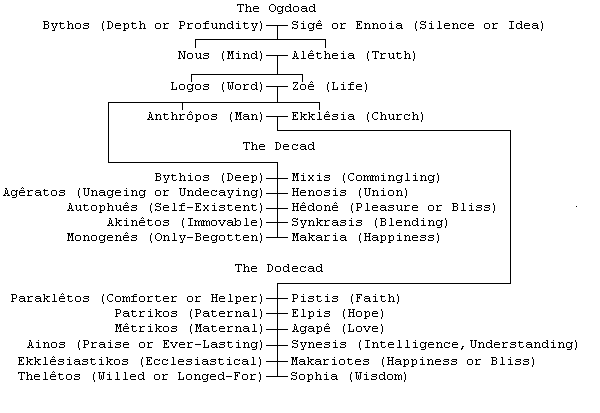
2. The Holy Father emanated 30 odd Aeons in pairs of syzgies and held their perfection with in himself and did not gave it to them. Its not that the Holy Father is jealous because what jealousy could there be between him and his Aeons. The Holy Father wishes that his Aeons love him and return to him so that they can end their wearying search for the Father and come to rest with him and there by receive their perfection. The Aeons exist inside the womb of the Father and emanate from him and yet they do not recognize or perceive the One in whom they were.

                 The Thirty Aeons of the Pleroma emanated by the Holy Father


3. Sophia, the last of the Aeons wishes to know the Father and her passion to know the Father grows and she commits an error.

4. The bad elements emanating from Sophia is combined to form Achamoth (also called Lower Sophia) and she is cast out of the Pleroma as her existence inside it destabilizes the equilibrium of the Pleroma.

5. Achamoth sheds her tears and wish to return to the Pleroma.

6. With the permission of the Father the Aeons emanate an another pair of zygies (Aeon pairs) namely Christos and the Holy Spirit to save Achamoth.

7. Christos and the Holy Spirit emanate Christ - The common fruit of the Pleroma.

8. Christ, the Saviour receives a part of light from every Aeon in the Pleroma and therefore In Christ dwells all the fullness of the deity in bodily form.

9. Christ, the Saviour orders Achamoth to bring forth the Demiurge, the God of the Jews or Jehovah because the spiritual seeds produced from their union needed a place for it to grow.

10. Human beings are the breeding ground for the seeds of Achamoth, the Lower Sophia and hence the Valentinians had a very positive attitude towards procreation and marriage.

11. The Demiurge, the God of the Jews having created the earth and the heavens said that I am God and there is no God before me due to his stubborn ignorance without knowing that all along he was indirectly guided by Achamoth who secretly sown the spiritual seed in every human being.

12. The Demiurge, the God of the Jews is the Father of the Devil. Yes, the devil has a father and it is none other than Jehovah.

13. The Devil, the liar and his evil Archons rule this earth and they occupy the heart of men making them vulnerable to sin and drive men away from the truth.

14. The Demiurge sends his son Jesus as the messiah of the Jews to proclaim his message and to fulfil the prophecy of the Prophets.

15. Christ, the Saviour descends onto the body of Jesus in the form of a dove when he was baptized by John the Baptist and as soon as Jesus raised from the Holy water he showed contempt to this world and laughed at this imperfect creation which was modelled according to the Pleroma above.

16. Jesus used to often kiss Mary Magdalene on her mouth and she was probably his companion. Jesus loved Mary more than the rest of the Apostles and silenced Peter who always objected to Mary's leadership during the early times of the church. The Saviour offered a way for women too to enter into heaven.

17. Judas Iscariot was the only one who truly understood the Saviour and Christ ordered Judas to hand him over to the Romans so that Christ could finally be freed from his material bondage with Jesus.

18.  The Saviour, possessing a spiritual body did not suffered at the cross and was mocking at the Pharisees by sitting on the branch of a tree. The Pharisees did not knew whom they were piercing with.

19. God, the Demiurge took the soul of Jesus and he will stand at the right hand of God till the end of times.

20. The Saviour then resurrected the body of Jesus and appeared to Mary first in the form of a vision and to the rest of the Apostles. The Saviour came back only in the likeness of the flesh and the Valentinians did not believed in bodily resurrection.

21. The Saviour appeared to Saint Paul on the road of Damascus and gave him the Pleromic revelation, the greatest mystery ever revealed to mankind. The Saviour chose Paul to take the good news of the Gospel to the Gentile nations and hence he was called as the Apostle to the Gentiles. The Saviour also appeared to Valentinus in the form of a vision of a young child and after few years ascended back to the Pleroma.

22. Therefore there is one Pneumatic Christ at the Pleroma level and there is an another psychic Christ who is the son of the Demiruge, the God of the Jews at the Kenoma level.

23. The psychic Christ is the one whom the Roman Catholics worship and they too will receive a lower salvation in the end.

24. The Pneumatics are those who have a pure heart and they are preordained to be saved by their nature and not by works of the Law. The Pneumatics cannot sin because God's very nature is in them. The Pneumatics cannot boast about anything no matter what and they have to be humble, strong and lead a sinless existence with the help of gnosis which they have received from the Pneumatic Christ.

25. The Psychics on the other hand do have free will and depending on their works of the Law they either chose to give their heart to the Demiurge or to the Devil.

26. The Hylics namely atheists are the sons of devil and these Hylics who worship matter which is evil will perish along with it at the end of the cosmos.

27. The Demiurge, the God of the Jews is the Centurion described in the Bible who will run towards Christ during the end times when he realizes the One who brought forth him into existence.

28. The Pneumatics perform the Bridal Chamber ritual which is holy of the holiest and unite with their angelic counterparts in the Pleroma.

29. The Roman Catholics, the Protestants, the Mormons and other countless sects of Christianity who are lower Christians will wait with the Demiurge till the end times and they too will return to the Pleroma and receive their angelic counterparts and join the common feast of the Pleroma. So the only difference between the Pneumatics and Psychics is only in the timing of their redemption. The Pneumatics redeem themselves here and now with the help of gnosis and unmerited grace and the Psychics on the other hand are saved by blind faith and by the works of the Law.

30. Everything happens according to the will of the Father and no one can receive gnosis without Faith.


Friday, 9 January 2015

Dr. Einar Thomassen speaks on Valentinus and the Valentinian tradition


Dr. Einar Thomassen is the author of the book The Spiritual Seed: The Church of the Valentinians and he is the first gnostic scholar apart from Elaine Pagels to have made a succinct formulation of the Valentinian system. His doctoral research was made on Tripartite Tractate, a Valentinian text which fully describes the Valentinian view of the cosmos. I really don't have to say anything else as Einar Thomassen has beautifully described our doctrine with his own words and I have nothing to object.

I would just like to add that if there is any Valentinian text that I would always like to keep it with me till my death then it will be the Gospel of Truth. In fact Einar Thomassen said in an another interview, "Not every time he (Valentinus) sat down to write a Gospel (Gospel of Truth) where he was going to throw in all the cosmology, cosmogony and the theogony." If anyone wants to understand the Valentinian system I would highly recommend reading Gospel of Truth because it was probably written by the great Valentinus himself. 

Saint Paul was a Gnostic and the Valentinians were the great Paulinists and what better proof for this theory than the work of Elaine Pagels, The Gnostic Paul. Christ will never ever forgive those who persecuted the Valentinian Christians. But as Valentinus himself says we should not take error too seriously because all the evil that humans commit in this world is because they are ignorant of the Father and gnosis is the only way to end human suffering and evil in this world but to receive gnosis you need faith. "No one can receive gnosis without faith." (Gospel of Philip)

While I write this my heart bleeds at the way that these sensitive Christians were burnt alive by the so called orthodox church authorities.

Tuesday, 18 November 2014

A Pagan Gnostic Christian?

Paganism and orthodox Christianity are entirely incompatible. The God of the Old Testament is a jealous god and wants all heathens to be destroyed since they honour and worship other gods rather than him. Many fundamental Christians if given a chance will stone heathens to death because it is said in their bible that anyone who serve other gods than Jehovah who brought Jews out of the land of Egypt must be stoned to death (Deuteronomy) and killed.

Pagan doctrines are a big heresy to the church.

Paganism vs Orthodox Christianity

  1. Emanationism vs Creationism
  2. Reincarnation vs Bodily resurrection
  3. Hard Polytheism vs Monotheism
  4. They practise Idolatry vs They flee from Idolatry
  5. Are exempted from all Divine Laws vs Are compelled to follow a Divine Law
  6. Redemption via Wisdom vs Redemption via blind faith
  7. Man is a puppet and has no free will vs Man has free will and is responsible for his actions
  8. Mystical union with Gods vs Subordinate to God
  9. Believe in Karma vs Believe in Original Sin
  10. Sun worship vs Sun worship is Devil worship
As you can see Paganism agrees next to nothing with orthodox Christianity. If this is the case people might be wondering how one can call himself a Pagan Christian. The missing link between Paganism and Christianity is Gnosticism.

Crossing Borders: Combining Paganism and Gnostic Christianity

A Pagan and a Christian holding a truth in agreement. St Paul, the apostle to the Gentiles who worked so hard to bring even Gentiles into the ministry of Jesus Christ. You are neither Jew nor a Greek but one in Christ. Jesus belongs to the Pagans too. Its not my intention to offend any orthodox Christians but this is what I truly believe and this is the truth. Jesus was sent by the Demiurge, The God of Old Testament, Jehovah and Christ who went inside Jesus's body at the time of his Baptism in the form of a dove was sent by the all loving Holy Father from whom all things have come and for whom we live.

Sunday, 29 September 2013

Localization of the Pleroma: Where do the Gnostics stand?

If anyone had carefully read my posts I repeatedly assert that Pleroma has a local existence, what do I mean by that? Well, if you have read "On the meaning of the Pleroma" by J.B Lightfoot you would probably get an idea as to from where I'm coming from. I did gave a link in an another post to this work but I think most of them do not care to read it.

Thanks to J.B Lightfoot,
-------------------------------------------------------------------------------------------------------------------------------------------------------------------------------------------------------------------------------------------------------------

On the meaning of the word Pleroma

"When we turn from Catholic Christianity to the Gnostic sects we find this term used, though (with one important exception) not in great frequency. Probably however, if the writings of the earlier Gnostics had been preserved, we should have found that it occupied a more important place than at present appears. One class of early Gnostics separated the spiritual being Christ from the man Jesus ; they supposed that the Christ entered Jesus at the time of His baptism and left him at the moment of His crucifixion. Thus the Christ was neither born as a man nor suffered as a man. In this way they obviated the difficulty, insuperable to the Gnostic mind, of conceiving the connexion between the highest spiritual agency and gross corporeal matter, which was involved in the Catholic doctrine of the Incarnation and Passion, and which Gnostics of another type more effectually set aside by the theory of docetism, i.e. by assuming that the human body of our Lord was only a phantom body and not real flesh and blood.

Irenaeus represents the former class as teaching that 'Jesus was the receptacle of the Christ', and that the Christ 'descended upon him from heaven in the form of a dove and after He had declared (to mankind) the nameless Father, entered (again) into the pleroma imperceptibly and invisibly. Here no names are given. But in another passage he ascribes precisely the same doctrine, without however naming the pleroma, to Cerinthus. And in a third passage, which links together the other two, this same father, after mentioning this heresiarch, again alludes to the doctrine which maintained that the Christ, having descended on Jesus at his baptism, 'flew back again into His own pleroma' In this last passage indeed the opinions of Cerinthus are mentioned in connexion with those of other Gnostics, more especially the Valentinians, so that we cannot with any certainty attribute this expression to Cerinthus himself. But in the first passage the unnamed heretics who maintained this return of the Christ 'into the pleroma are expressly distinguished from the Valentinians ; and presumably therefore the allusion is to the Cerinthians, to whom the doctrine, though not the expression, is ascribed in the second passage. Thus there seems to be sufficient reason Connexion for attributing the use of the term to Cerinthus This indeed is probable of this use on other grounds. The term pleroma, we may presume, was common to St Paul and the Colossian heretics whom he controverts. To both alike it conveyed the same idea, the totality of the divine powers or attributes or Colossiaa agencies or manifestations. But after this the divergence begins. The heretics, maintained that a single divine power, a fraction of the pleroma, resided in our Lord : the Apostle urges on the contrary, that the whole pleroma has its abode in Him-. The doctrine of Cerinthus was a development of the Colossian heresy, as I have endeavoured to show above. He would therefore inherit the term pleroma from it. At the same time he seems to have given a poetical colouring to his doctrine, and so doing to have treated the pleroma as a locality, a higher spiritual region, from which this divine power, typified by the dove-like form, issued forth as on wings, and to which, taking flight again, it reascended before the Passion. If so, his language would prepare the way for the still more elaborate poetic imagery of the Valentinians, in which the pleroma, conceived as a locality, a region, an abode of the divine powers, is conspicuous.

The attitude of later Gnostics towards this term is widely divergent. The term The word is not, so far as I am aware, once mentioned in connexion with avoided by the system of Basilides. Indeed the nomenclature of this heresiarch, longs to a wholly different type ; and, as he altogether repudiated the doctrine of emanations*, it is not probable that he would have any fondness for a term which was almost inextricably entangled with this doctrine.

On the other hand with Valentinus and the Valentinians the doctrine of the pleroma was the very key-stone of their system; and, since at first in sight it is somewhat difficult to connect their use of the term with St Paul's, a few words on this subject may not be out of place.

Valentinus then dressed his system in a poetic imagery not unlike the myths of his master Plato. But a myth or story involves action, and action requires a scene of action. Hence the mysteries of theology and cosmogony and redemption call for a topographical representation, and the pleroraa appears not as an abstract idea, but as a locality.

Topogra- The Valentinian system accordingly maps out the universe of things great regions, called respectively the pleroma and the kenoma, the 'fulness' and the 'void'. From a Christian point of view these may be described as the kingdoms of light and of darkness respectively. From Antithesis the side of Platonism, they are the regions of real and of phenomenal of pleroma existences — the world of eternal archetypes or ideas, and the world of material and sensible things. The identification of these two antitheses was rendered easy for the Gnostic ; because with him knowledge was one with morality and with salvation, and because also matter was absolutely bound up with evil. It is difficult to say whether the Platonism or the Christianity predominates in the Valentinian theology ; but the former at all events is especially prominent in their conception of the relations between the pleroma and tlie kenoma. The pleroma is the abode of the AEons, who are thirty in number. These AEons are successive emanations, of which the first pair sprang immediately from the pre-existent Bythus or Depth. This Bythus is deity in itself, the absolute first principle, as the name suggests ; the profound, unfathomable, limitless, of whom or of which nothing can be predicated and nothing known. Here again we have something like a local representation. The AEons or emanations are plainly the attributes and energies of deity ; they are, or they comprise, the eternal ideas or archetypes of the Platonic philosophy. In short they are deity relative, deity under self-imposed limitations, deity derived and divided up, as it were, so as at length to be conceivable.

The topographical relation of Bythus to the derived AEons was differently given in different developments of the Valentinian teaching. According to one representation he was outside the pleroma; others placed his abode within it, but even in this case he was separated from the rest by Horus {"Opos), a personified Boundary or Fence, whom none, not even the AEons themselves, could pass^ The former mode of representation might be thought to accord better with the imagery, at the same time that it is more accurate if regarded as the embodiment of a philosophical conception. Nevertheless the latter was the favourite mode of delineation; and it had at least this recommendation, that it combined in one all that is real, as opposed to all that is phenomenal. In this pleroma every existence which is supra-sensual and therefore true has its abode.

Separated from this celestial region by Horus, another Horus or Kerwma, Boundary, which, or who, like the former is impassable, lies the ' kenoma ' the region or void '—the kingdom of this world, the region of matter and material things, the land of shadow and darkness Here is the empire of the Demiurge or Creator, who is not a celestial Man at all, but was born in this very void over which he reigns. Here reside all those phenomenal, deceptive, transitory things, of which the eternal counterparts are found only in the pleroma.

It is in this antithesis that the Platonism of the Valentinian theory Platonism reaches its climax. All things are set off one against another in these two of this antithesis.

The swan on still St Mary's lake
Floats double, swan and shadow.

Not only have the thirty AEons their terrestrial counterparts; but their subdivisions also are represented in this lower region. The kenoma too has its ogdoad, its decad, its dodecad, like the pleroma. There is one Sophia in the supra-mundane region, and another in the mundane; there is one Christ who redeems the AEons in the spiritual world, and a second Christ who redeems mankind, or rather a portion of mankind, in the sensible world. There is an Aeon Man and another Aeon Ecclesia in the celestial kingdom, the ideal counterparts of the Human Race and the Christian Church in the terrestrial. Even individual men and women, as we shall see presently, have their archetypes in this higher sphere of intelligible being.

The localisation of the plerOma carried out in detail. 

The topographical conception of the pleroma moreover is carried out in the details of the imagery. The second Sophia, called also Achamoth, is the desire, the offspring, of her elder namesake, separated from her mother, cast out of the pleroma, and left ' stranded ' in the void beyond^, being prevented from returning by the inexorable Horus who guards the frontier of the supra-mundane kingdom. The second Christ — a being compounded of elements contributed by all the AEons— was sent down from the pleroma, first of all at the eve of creation to infuse something like order and to provide for a spiritual element in this lower world ; and secondly, when He united Himself with the man Jesus for the sake of redeeming those who were capable of redemption^. At the end of all things Sophia Achamoth, and with her the spiritual portion of mankind, shall be redeemed and received up into the pleroma, while the psychical portion will be left outside to form another kingdom under the dominion of their father the Demiurge. This redemption and ascension of Achamoth (by a perversion of a scriptural image) was represented as her espousals with the Saviour, the second Christ; and the pleroma, the scene of this happy union, was called the bridal-chamber Indeed the localisation of the pleroma is as complete as language can make it. The constant repetition of the words * within * and 'without', 'above' and 'beneath', in the development of this philosophical and religious myth still further impresses this local sense on the term^.

In this topographical representation the connexion of meaning in the word pleroma as employed by St Paul and by Valentinus respectively seems at first sight to be entirely lost. When we read of the contrast between the pleroma and the kenoma, the fullness and the void, we are naturally reminded of the plenum and the vacuum of physical speculations. The sense of pleroma, as expressing completeness and so denoting the aggregate or totality of the Divine powers, seems altogether to have disappeared. But in fact this antithesis of Keuwfia was, so far as we can make out, a mere afterthought, and appears to have been borrowed, as Irenaeus states, from the physical theories of Democritus and Epicurus^. It would naturally suggest itself both because the opposition of ifK-qpr^s and K€vos was obvious, and because the word Kevcofia materially assisted the imagery as a description of the kingdom of waste and shadow. But in itself it is a false antithesis. The true antithesis appears in another, and borrowed probably an earlier, term used to describe the mundane kingdom.

In this earlier representation, which there is good reason for ascribing to Valentinus himself, it is called not Kevafia ' the void', * the deficiency, incompleteness '1. Moreover the common phraseology of this appears in Valentinian schools shows that the idea suggested by this opposition to theirs was not the original idea of the term. They speak of the whole aggregate of the AEons. And this (making allowance for the personification of the Aeons) corresponds exactly to its use in St Paul.

Again the teaching of the Valentinian schools supplies other uses which serve to illustrate its meaning. Not only does the supra-mundane kingdom as a whole bear this name, but each separate AEon, of which that shown kingdom is the aggregation, is likewise called a pleroraa This designation is given to an AEon, because it is the fullness, the perfection, of which its mundane counterpart is only a shadow and defective copy. Nor does the narrowing of the term stop here. There likewise dwells in this higher region a pleroma, or eternal archetype, not only of every comprehensive mundane power, but of each individual man; and to wed himself with this heavenly partner, this Divine ideal of himself, must be the study of his life. The profound moral significance which underlies the exaggerated Platonism and perverse exegesis of this conception will be at once apparent.

But the manner in which the theory was carried out is curiously illustrated by the commentary of the Valentinian Heracleon on our Lord's discourse with the Samaritan woman"*. This woman, such is his explanation, belongs to the spiritual portion of mankind. But she had had six husbands, or in other words she laid entangled herself with the material world, had defiled herself with sensuous things. The husband however, whom she now has, is not her husband; herein she has spoken rightly: the Saviour in fact means 'her partner from the pleroma'. Hence she is bidden to go and call him ; that is, she must find ' her pleroma, that coming to the Saviour visit him (or it), she may be able to obtain from Him the power and the union and the combination with her pleroma' {rfiv bvvap.iv Koi TTjv evcocriv koI ttjv avaKpacriv rffv Trpbs to irKr^papa avTTjs), * For', adds Heracleon, ' He did not speak of a mundane {KoaptKov) husband when He told her to call him, since He was not ignorant that she had no lawful husband'.

Impossible as it seems to us to reconcile the Valentinian system with the teaching of the Apostles, the Valentinians themselves felt no such difficulty. They intended their philosophy not to supersede or contradict Apostolic doctrine, but to supplement it and to explain it on philosophical principles. Hence the Canon of the Valentinians comprehended the Canon of Catholic Christianity in all its essential parts, though some Valentinian schools at all events supplemented it with Apocryphal writings. More particularly the Gospel of St John and the Epistles to the Colossians and Ephesians were regarded with especial favour; and those passages which speak of the pleroma are quoted more than once in their writings to illustrate their teaching. By isolating a few words from the context and interpreting them wholly Without reference to their setting, and quote they had no difficulty in finding a confirmation of their views, where we see them in only an incongruity or even a contradiction. For instance, their second Christ — the redeemer of the spiritual element in the mundane world — was, views. as we saw, compacted of gifts contributed by all the Aeons of the pleroma. Hence he was called ' the common fruit of the pleroma', ' the fruit of all the pleroma'^, 'the most perfect beauty and constellation of the pleroma; hence also he was designated 'All' (natf) and 'All things' (navTay.

Accordingly, to this second Christ, not to the first, they applied these texts; Col. iii. 11 * And He is all things', Rom. xi. 36 'All things are unto Him and from Him are all things'. Col. ii. 9 ' In Him dwells all the fulness of the Godhead', Ephes. i. 10 ' To gather together in one all things in Christ through God '2. So too they styled him EvdoKrjTos, with a reference to Col. i. 19, because 'all the pleroma was pleased through Him to glorify the Father'^ And inasmuch as this second Christ was according to the Valentinian theory instrumental in the creation of the mundane powers, they quoted, or rather misquoted, as referring to this participation in the work of the Demiurge, the passage Col. i. 16 ' In Him were created all things, visible and invisible, thrones, deities, dominions'*. Indeed it seems clear that these adaptations were not always afterthoughts, but that in several instances at least their nomenclature was originally chosen for the sake of fitting the theory to isolated phrases and expressions in the Apostolic writings, however much it might conflict with the Apostolic doctrine in its main lines°. "


--------------------------------------------------------------------------------------------------------------------------------------------------------------------------------------------------------------------------------------------------------------
Saint Paul was right, all the pleroma(totality of divine powers or Aeons) of deity(Father) dwells in Christ and form his body and moreover this pleroma has a local existence, it locally exists just as it is said in the Gospel of Thomas - "The kingdom of God is spread out upon earth but men don't see it".

As anyone can see Christ is at the very heart of the doctrine of Valentinian theology it is ridiculous to assert that there is no special place for Christ in Valentinian theology or in gnosticism as a whole. Christ is at the very soul of their doctrine.