Showing posts with label Valentinianism. Show all posts

Sunday, 5 February 2017

We're all females, there are no males in the world

We are all brides of the Bridal Chamber (Pleroma) who are waiting to unite with the bridegrooms of the Saviour. We are the weak female seeds of Achamoth, the lower Sophia who aborted us out of joy when she saw the Saviour descending from the above Pleroma to save her.

In fact it was for this reason that the Saviour requested Achamoth to bring forth the Demiurge, Jehovah whom was used as a tool to create the heaven and the earth in the image of the above Pleroma for the sole purpose of providing a space for the spiritual seeds of Achamoth to grow and become mature.

As long as we were children of the female only, as of a dishonorable union, we were incomplete, childish, without understanding, weak, and without form, brought forth like abortions, in short, we were children of the woman. But having been given form by the Savior, we are the children of the man (husband) and of the bride-chamber (Excerpta ex Theodoto 68).
When Peter objected to Mary's presence by saying, "Make Mary leave us, for females don't deserve life." in the Gospel of Thomas. Jesus defended Mary by saying, "Look, I will guide her to make her male, so that she too may become a living spirit resembling you males. For every female who makes herself male will enter the kingdom of Heaven.". The above statement by Jesus should not be interpreted as meaning females are not allowed in heaven instead it should be interpreted in the light of the Valentinian Bridal Chamber meaning that we are all female brides who have to make ourselves as males in order to enter the kingdom of Heaven.

Jesus said to them, "When you make the two into one, and when you make the inner like the outer and the outer like the inner, and the upper like the lower, and when you make male and female into a single one, so that the male will not be male nor the female be female, when you make eyes in place of an eye, a hand in place of a hand, a foot in place of a foot, an image in place of an image, then you will enter [the kingdom]."

When we female brides unite with the male bridegrooms of the Saviour in the Bridal Chamber we will become androgynous beings who are neither males nor females. No one can enter the Pleroma without pairs or without male and female consorts or syzygies. This is the will of the Father and this is the reason why the Saviour has created the bridegrooms for our sacramental marriage with them in the Bridal Chamber.

Sunday, 24 July 2016

Ptolemy's Letter to Flora is truly a gem of a work

Ptolemy's letter to Flora is a slap on those who believe that the Gnostics were not intellectuals and believed in some nonsensical mythical beliefs produced from their own little fantasies. 

Ptolemy's letter to Flora is a fine introduction to the unique thinking and attitude of the Valentinians which can be preached to all the masses irrespective of their psychic, pneumatic or hylic nature as it does not contain any esoteric stuff like in the other Valentinian texts like the Gospel of Philip and the Gospel of Truth.


Some of the interesting and factual ideas that come out of this outstanding letter are:

The Torah Law and its commandments is quite alien to the nature and thought of the perfect Father of all.

The Holy Father who is above Jehovah in the above Pleroma is not a person who judges on humanity instead he unconditionally loves all of humanity by giving us unmerited grace and sows the spiritual seed in all of us. In fact he has pre-ordained this cosmos in order to provide salvation to all of humanity. Our salvation is inevitable no matter what sins we commit or what good things we achieve. It is only a matter of time that one receives salvation early and others receive it late. The perfect Holy Father does not condemn humanity by placing eternal damnation of sins on them. In fact we all are above sin because we are not responsible for the events which are occurring in this world because everything is working according to the will of the Father.

The Law giver Jehovah is not an evil god but a just one.

This is the unique belief of the Valentinians compared to the other gnostic sects like the Sethians who taught that the creator and the world to be evil. Ptolemy criticizes those who believe that the law giver and the creator of this world is the highest God and equally criticizes those who believe on contrary that he was the Devil.

The tripartite division on the just but incomplete Laws of Jehovah and the imperfect unjust Laws of Moses and the elders of the Jewish people.

Ptolemy teaches us that the Saviour approved the Torah (The laws of Jehovah) but rejected the Halakha (The Jewish interpretation of the Law by its elders). The historical Jesus on many different occasions broke many laws of the Old Testament like the Sabbath and defended his actions impeccably against his accusing Pharisees by explaining and providing the true purpose of those laws given by Jehovah and accused back at the Pharisees and silenced them in having not understood the true purpose of those laws and striving away from them by following the unjust laws established by the elders of the Jewish people.

The Saviour came to fulfill and complete the Laws of Jehovah and not to nullify it.

This is the idea which should receive much attention and I hope this perception at least stops all the Pauline hate that goes on among the Jewish Christian circles like the Ebionites, among atheists who try to seek contradictions in the bible and among Christians who doubt and hate Paul.

When people find what Jesus says in Matthew that he has not come to abolish the Law but to fulfill it until the last stroke of every prophecy is fulfilled and when on the other hand they see Paul teaching that people are saved apart from the works of the Law and nullifies the Law, the Jewish Christians raise a huge tumult against Paul and accuse him as a false apostle and atheists in seeing these contradictions come to the hopeless conclusion that the bible was written by human goat herders lacking any kind of divine intervention and inspiration. Scholars doesn't do much to stop this misery and add their own stubborn prideful views.

Ptolemy teaches us that the Saviour not only came to fulfill the Law but to complete it and it was this completion and perfection of the Old Testament Law which was the good news preached by Paul in his Gospel and people often misunderstand Paul as contradicting and not giving any credit to the historical Jesus in his writings, on the contrary Paul was the only one who truly understood the mind and the thought of the Saviour. This is the reason the Valentinians revered and respected him so much.

15 “Go!” said the Lord. “This man (Paul of Tarsus) is My chosen instrument to carry My name before the Gentiles and their kings, and before the people of Israel. 16 I will show him how much he must suffer for My name.” 17 So Ananias went to the house, and when he arrived, he placed his hands on Saul. “Brother Saul,” he said, “the Lord Jesus, who appeared to you on the road as you were coming here, has sent me so that you may see again and be filled with the Holy Spirit.” (Acts 9:15-17)

Tuesday, 19 July 2016

Catholicism was constructed as a defense against Marcion


What a load of shitty speculation right over there! The claim that Marcion and his followers namely the marcionites wrote the Pauline corpus is very absurd. Marcion was the man who believed that only Paul understood the true message of Christ and rejected the Old Testament and its Jewish god Jehovah completely. So for Marcion, a ship owner of Pontus to convert and arrive at the conclusion of Marcionism the Pauline Epistles must already have been in existence for him to get influenced by Paul and his teachings. Robert Price knows that this version of his view is actually a chicken and the egg problem. Marcion wrote the Pauline letters but for Marcion to get influenced in order to write the Pauline letters the Pauline corpus must have been in existent before Marcion became active.

To tackle this problem he makes an even more absurd claim that Simon Magus was actually Saint Paul of Tarsus. We cannot rely on the information of Simonism from Irenaeus because in a hurry to refute the heretics he took whatever sources that was available to him without checking there credibility and therefore his works are very unreliable. In fact the Gnostic systems which he attributed to Valentinus was not the actual system which Valentinus himself believed in instead his accusations were directed to the later modified systems of Valentinian followers like Heracleon and Ptolemy. So are the clementine homilies which cannot be trusted.

Secondly, one of the other argument of Robert Price is that there are contradictions with in the Pauline Corpus for example comparing Corinthians and Galatians where Paul says that he received his wisdom of Christ while talking with the elders of Jerusalem and on the other hand in Galatians he says that his teachings were mainly derived from his personal revelations of divine and not taught by any human or angel. Robert Price thinks that such contradictions shouldn't be there in a corpus if it was claimed to be written by only one man so he concludes that Marcion wrote Galatians.

What I believe is that instead of Marcion writing Galatians it is more likely that the sentinels of the Catholic church edited Corinthians to make it appear more mainstream and made it leaning towards their own dogmatic beliefs. Suppressing the truth that the relationship between Paul and the church at Jeruasalem was not smooth and suppressing the portrayal of a zeolot anti-Semitic Paul who used to accuse them straight on their faces.

The last idea of Paul being Simon Magus is ridiculous because:

  • Paul was a tent maker while Simon was a sorcerer.
  • Paul was born and brought up in Tarsus while Simon was from Gitta, a village in Samaria.
  • Paul loved the Gentiles and his mission was directed towards the Gentiles but we have no evidence to prove that Simon had any interests in converting and persuading the Gentiles to the ministry of Jesus. Paul's division of teaching one thing to the Jews and another to the Gentiles appears as early as in Romans.
  • Paul displayed sensitivity towards a wide range of complex issues but Simon lacked any such sensitivity.
  • It was Saul who was under the tutelage of the great Gamaliel and not Simon.
  • It was Saul who was struck blind fold on his road to Damascus and not Simon.
  • It was Paul who held a Roman citizenship and could fluently read and write Greek and not Simon.
Marcion may have indeed been the first person to collect the different Pauline letters and showed the value of them to the world and his polemic indeed triggered his rivals to establish a different canon of their own by editing and adding verses and by forging new Gospels in the name of Paul which suited to their own agendas. Well if not Marcion I am damn sure Valentinians would have collected and compiled the Pauline Corpus irrespective of whether Marcion collected it or not because no one on earth loved Paul so much other than the Valentinians. Even the Gospel of John has gone through a series of successive editions before making it to the biblical canon of the Catholics because there are many verses in them which are offensive to the Gnostics and equally there are anti-Semitic verses in it which goes to the extreme supporting Gnosticism in full force. All this shows that the New Testament as we have today is not the same version as people saw it two thousand years ago.

The real historical Paul was never really like the Paul of the Catholics as we know today. He was a zealot anti-Semite and more of a Valentinian than a Catholic.

Sunday, 26 June 2016

As a Gentile, I have a huge respect for Saint Paul

I am a Gentile, a non-Jew, a follower of Helios-Mithras. Why would a hard polythiestic like me would revere and honor the promoter of a monotheistic religion? There is one man who stands in between preventing a bloody war between the Pagans (a pejorative word used by Christians against us)  and the Christians and that man is Saint Paul of Tarsus. I don't think I would ever love Christ and Christianity if not for Saint Paul. If I ever love Christianity it is only because of Paul and his Pauline letters.

Why do I love Paul and revere him so much? Is it because he was the Apostle to the Gentiles and understood us much better than anyone else? No. Is it because he favored us over the Jews or do I love him because of his anti-Semitism? No. Is it because he amalgamated the doctrine of pagan mystery religions into Christianity? No. 

Paul's main concerns and his main beliefs clearly shows out in the Colossian heresy, on the Divinization of Christ. The Colossian heretics insisted that only a part of the divinity was in Christ and involved themselves in the "worship of angels" and were trying to ascend to the heavens of these angels and finally to Christ. Paul on the other hand slams such a doctrine and teaches them that there is no need to "worship the angels" as all the angels or divine powers resided in Christ in bodily form.

This might have been the revelation that Paul received on his road to Damascus, the truth that "In Christ dwells all the pleroma of the deity in bodily form." (Colossians 2:9). This is exactly the revelation Valentinus received after a century or so, "It was quite amazing that the Aeons were in the Father and were able to emanate in as much as they were not able to perceive and recognize the one in whom they were." (Gospel of Truth)

This form of worship where you worship the divinity as a whole is called the samashti swaroopa of Vedic worship also called as Akhand Upasana. It is this knowledge of Paul and Valentinus which is mentally disturbing for me and the reason why I revere them so much.

It is only through revelation that such an esoteric doctrine can be obtained not just through mere copying from other pagan mystery religions and the way Paul vehemently defended and fanatically preached such a doctrine even to the point of martyrdom says something about the confidence which Paul and Valentinus had on their doctrines. Was Christ the heavenly counterpart to the earthly Jesus might have been originally sent by Savitr, the Holy Father of the Vedic Aryans? Why would the magi from the east who worshiped Mithras bring gifts to a Jewish messiah while he was still an young boy? All this only makes perfect sense if we take the Valentinian, 'Fall of Sophia' myth quite seriously.

Friday, 18 December 2015

Sexual intercourse for producing spiritual children

Marriage and Procreation were an hotly debated topic among early Christian fathers. What should be the attitude of Christians on procreation, sex and marriage? While I cannot speak for all Christians and for all sects of Christianity out there I will be more concerned with the attitude of those Christians who believed in the same doctrines which I believe in. In this case I am concerned of Valentinianism and the attitude of Valentinian Christians on marriage, procreation and celibacy which is my main concern since I am a Valentinian Christian.

April D DeConick from the Rice University has made a thorough study on this subject and her work The Great Mystery of Marriage. Sex and Conception in Ancient Valentinian Traditions will be the main subject of this post.

April proposes a unique view not supported by reputable scholars in the field by saying that Valentinians neither advocated celibacy nor did they practised promiscuous sexual intercourse but instead they had pure sexual intercourse to bring forth children possessing divine qualities in them or in other words children with a pneumatic spiritual seed in them.

Its true that the positive attitude on marriage and sex by the Valentinian Christians is due to their high emphasis on mythogony. Their eschatology is a consequence of their mythology and their positive attitude on marriage and sex is a consequence of their eschatology. According to them myth was far more real than ordinary reality. Achamoth, also called the Lower Sophia brings forth spiritual fetuses or seeds out of joy after seeing Jesus along with his angels descending to her realm from the above Pleroma. Since these spiritual seeds were conceived without a proper sexual intercourse between Achamoth and Jesus these spiritual seeds were weak and immature and needed a place for them to grow and to become mature. It was then that Jesus ordered Achamoth to bring forth the Demiurge Jehovah so that she can use him as a tool to create earth and human beings. Therefore human beings are nothing but mere carrier bodies for the pneumatic spiritual seeds of Achamoth which she sows every time a child is conceived from a mother's womb.

Earlier I had argued that the Bridal Chamber should be interpreted allegorically as a union between the Holy Father and the individual obviously disturbed by the idea that Valentinians practised carnal sexual intercourse inside earthly Bridal Chambers. The Bridal Chamber in Gospel of Philip should be interpreted allegorically and spiritually. After reading the work of April D DeConick I have to accept that I was wrong and I have to advocate the view that the Valentinians might have had a pure sexual intercourse inside Bridal Chambers just to produce children possessing divine qualities. We cannot be sure because remember Gospel of Philip insists that the marriage in the Bridal Chamber is not fleshy.

However I don't think that marriage and sexual intercourse was so important a thing for Valentinians as April makes it out in her work. The reason being if marriage and procreation were so important to Valentinians then Saint Paul would have obviously stressed more on this point and would have recommended us to strictly marry without fail at least for the sake of bringing forth spiritual children instead Paul advocates the view that it is better to remain as a celibate but if men cannot control then he says it is better to marry rather than to burn with the passion of lust which is completely in contrast with the view espoused by April D DeConick in her work.

Marriage and procreation should be of secondary priority and importance for human beings since it is not mandatory that you should be married to receive redemption instead one should worship only the Holy Father through sacraments and become like the Holy Father which is a view also espoused by the same Gospel of Philip.

It is not possible for anyone to see anything of the things that actually exist unless he becomes like them. This is not the way with man in the world: he sees the sun without being a sun; and he sees the heaven and the earth and all other things, but he is not these things. This is quite in keeping with the truth. But you saw something of that place, and you became those things. You saw the Spirit, you became spirit. You saw Christ, you became Christ. You saw the Father, you shall become Father. So in this place you see everything and do not see yourself, but in that place you do see yourself - and what you see you shall become.

- Gospel of Philip
If time permits then one might concentrate on having sexual intercourse to produce spiritual children so that as many souls as possible receive the gnosis of the Father and return to the Pleroma as soon so possible but the main goal of human beings should be to be in search of the unknowable Holy Father through sacraments and to finally rest with him.

Even the Isha Upanishad advocates that man should live a hundred years without lusting after other men's possessions and without renouncing the works of the Law but one might question what good does it serve when this whole world is full of evil and not from the Father of Truth. If we press hard on the Aryan religion and demand an answer to this question it would go not quite far and they would give an answer like that this world was created for humans and gods so that they can live happily and peacefully here after through give and take i.e. humans should perform Yajna and offer sacrifices to the gods and gods should receive those sacrifices since Yajna is the food for the gods and in turn gods should fulfil the desires of human beings. In this way this world was created for gods and human beings to peacefully coexist and finally to establish the truth of Brahman and live a righteous life accordingly. In this sense the God of the Aryans is a loving god who cares for humanity and wants human beings to live on earth even though it is difficult just for the sake of establishing the truth and saving as many human beings as possible and finally return them to Pleroma. Even though the soteriology of the Aryans is quite similar to the Valentinians the former lack proper mythological explanations for their attitude towards the world and also on the question of how we got here in the first place. The myth of the Valentinians surpasses all religions in correctly communicating to us on questions like how we got here in the first place? Why there is so much evil in this world and why an omnibenevolent and an omnipotent God does not try to stop evil? Why do some people don't believe in any God while others easily believe in the truth? Why do bad things happen for good innocent people? What is the purpose of life? Why does the universe exist? Where do we come from? Where are we going? What should be our attitude? What should be our code of conduct? What should be our role in life? Who should follow the Law and who should not? When does the universe come to an end? We all are truly indebted to Valentinian Christians for their remarkable Depth Psychology on the human condition and behaviour, their insights on the cosmos and their way of creating myths to convey their fascinating ideas even embracing their opponents who think them as unintelligible mad men devoid of any rationality.

Saturday, 28 November 2015

My paper about Esotericism on Academia.edu

I don't believe in Intellectually property rights and neither did the Vedic rishis because all knowledge has come down to us from God and there is nothing for us to boast about.

There was no concept of intellectual property in the ancient world, and plagiarism was widely seen as a homage to the original author. The Stanford Encyclopedia claims "It must also be recognized that 'forgery' is a modern notion. Like Plotinus and the Cappadocian Fathers before him, Dionysius does not claim to be an innovator, but rather a communicator of a tradition."
However I would love to see my paper, Why the polytheistic mythos of the esotericists is inevitable?
published in an academic Eostericism journal but I seriously doubt anything like that even exists so I have uploaded a draft copy of my paper on Academia.edu so that at least others can benefit from my research and take it forward and review it.

Here is the updated draft copy.

Why the polytheistic mythos of the esotericists is inevitable?

Monday, 16 November 2015

Catholics should abandon the doctrine of Trinity

This is an another example of the hypocrisy of the Roman Catholic Church. Their utter foolishness in not recognizing that the doctrine of Trinity is a Gnostic doctrine. What kind of an orthodox church chooses a Gnostic doctrine as their foundational belief system and at the same time charge these same Gnostics for heresy when they themselves are believing in a Gnostic doctrine? Are they so blind or the God of this age has made them blind?

Father, Son and the Holy Spirit

Holy Spirit here actually represents the feminine goddess. In Valentinianism the Holy Father is androgynous, he is both male and female. In the psychic world the bride of Jesus Christ is Mary Magdalene who represent the Holy Spirit.
"Jesus Christ used to often kiss Mary Magdalene on her mouth."

- Gospel of Philip
How can these three individual distinct persons, the Holy Father, the Son (Jesus Christ) and the Holy Spirit (Sophia) can be one and the same thing? Mary Magdalene was Jesus Christ's companion in the psychic world. Its quite clear that these three persons are distinct individual beings and at the same time they are basically one and the same God. This can only be understood through Valentinian Monism.

Trinity is a disguised form of the doctrine of Emanationism.

The doctrine of Trinity indirectly implies Emanationism. The Father emanated the Son and the Holy Spirit which is in direct opposition to the creationism of Catholicism.

Marcellus of Ancyra warned the church fathers of the Nicene Creed to abandon the doctrine of Trinity as it was a Gnostic heresy.

In the fourth-century, Marcellus of Ancyra declared that the idea of the Godhead existing as three hypostases (hidden spiritual realities) came from Plato through the teachings of Valentinus, who is quoted as teaching that God is three hypostases and three prosopa (persons) called the Father, the Son and the Holy Spirit: 
"Now with the heresy of the Ariomaniacs, which has corrupted the Church of God... These then teach three hypostases, just as Valentinus the heresiarch first invented in the book entitled by him 'On the Three Natures'. For he was the first to invent three hypostases and three persons of the Father, Son and Holy Spirit, and he is discovered to have filched this from Hermes and Plato." 

Since Valentinus had used the term hypostases, his name came up in the Arian disputes in the fourth century. Marcellus of Ancyra, who was a staunch opponent of Arianism but also denounced the belief in God existing in three hypostases as heretical, and was later condemned for his views, attacked his opponents (On the Holy Church, 9) by linking them to Valentinus: 
"Valentinus, the leader of a sect, was the first to devise the notion of three subsistent entities (hypostases), in a work that he entitled On the Three Natures. For, he devised the notion of three subsistent entities and three persons — father, son, and holy spirit."

It should be noted that the Nag Hammadi library Sethian text Trimorphic Protennoia identifies Gnosticism as professing Father, Son and feminine wisdom Sophia or as Professor John D. Turner denotes, God the Father, Sophia the Mother, and Logos the Son.

Muslims are right in accusing Christians for practising Polytheism and Idolatry. 
  
The doctrine of trinity is nothing but Emanationism in a disguised form and there by, by believing in three distinct individual persons and by attributing a feminine companion to God the charge of the Muslims is absolutely right on Christians as it goes entirely against the will of their God Jehovah. We can safely conclude that Jehovah is not representing the Holy Father in the doctrine of Trinity as Saint Paul was a Gnostic and believed in a higher god above him who was residing inside the Pleroma.

The worship of Jesus Christ by nailing him to a cross and there by making an idol of him also goes against the will of their God Jehovah. Either Catholics should admit that they no longer believe in Jehovah, the God of the Old Testament or abandon the Gnostic doctrine of Trinity. I hate hypocrites.

Sunday, 3 May 2015

Gospel of Truth is truly a joy for all philalethists

"Gospel of Truth is a joy to those who have received from the Father of Truth the gift of knowing him."

At a time when I was starting to feel that there is no one on this planet who can understand my beliefs and went into a deep depression Christ, the saviour gave me a hope by introducing me to a 2nd century Gnostic Christian named Valentinus.

If there is ever a book which I want to keep in my hand till my last breathe then it would be this book because it defines me completely, my way of thinking and my way of living. When I was absolutely demoralized the one thing which gave me strength was Valentinus' Gospel of Truth. 

Gospel of Truth upheld my beliefs and made me a much stronger person than I was ever was by showing that I am not alone in all of this that once there lived people who shared the same beliefs which I had held on to.

It gave me that self evidential proof which I needed to confirm myself that my revelation was real and my scepticism about our place in the cosmos was right. When I could back up my beliefs with evidence from the Pauline Epistles originally written in Greek I couldn't have asked for anything more than this.

Yes, the Pleroma, the body of Christ exists and this world was modelled according to the Pleroma above and our world is not the only world that exists out there independent of us. This concept of Pleroma was the very keystone of the Valentinian theology or the Paul's Pleroma theology.

Right from my teenage I had a sufficient leaning towards the Pauline Epistles, after all he was the appointed Apostle to the Gentile nations and although the word Gentile in those days always meant Greeks the mission of Saint Paul was to spread the message of the Gospel to the whole world both to Gentiles and to non-Gentiles alike. I knew that Paul was saying something completely different from what the rest of the apostles were saying and many people were saying that he corrupted the teachings of Jesus, others called him a false Apostle and some even went as far as saying that Paul was a priest of Mithras. Yes, lots of theories were floating around and everyone thought that they had cracked the problem of Paul convincingly but I always believed that truth is far from what meets the eye.

It was only after studying Valentinianism I could truly appreciate the calibre and the divinity of the great doctor of the church, Saint Paul of Tarsus. I knew he was saying something very interesting but I still had to find that one clue which could finally allow me to speak good of him and Valentinianism was that one missing part of the puzzle.

The rest of the Bible though was always uninteresting to me as it is for all Gentiles which was opinionated by even Julian, the Emperor himself who said that Christianity was always presented to him in an uninteresting manner.

Some might be wondering how could a man like myself who practices hard polytheism can truly appreciate and admire the founder (Saint Paul of Tarsus) of a monotheistic religion (Christianity) who believes in the concept of Trinity, the Father, the son and the Holy Spirit. 

The answer to that is Jesus Christ never ever established any church on earth, he always taught that the church is the pleroma of God (Ephesians), he never ever envisioned a physical church here on earth and never ever appointed any Pope to preside over it. Contrary to the strong popular belief that Pauline Christianity won out against all other forms of Christianity it was neither the Pauline nor the Jesus of Nazareth's Christianity that won out instead what won out was the Christianity of the Byzantine empire, what won was Roman imperialism, what won was the Christianity of Constantine who wanted to use it as a political tool to control the masses and the current Roman Catholic Church is the product of this course of events.

Valentinian Christians are the true Pauline Christians who received a succession of apostolic tradition starting from Saint Paul himself. This is exactly what the gnostic Ptolemy writes in his letter to Flora that we too have received a genuine apostolic tradition. Catholics do not understand the Pauline Epistles they are in two minds when it comes to Pauline Epistles whether to completely do away with the Law as Paul instructs them or to fully abide by it as Jesus advises them in his sermon on the mount. When pressed hard to give an answer they often go mum without knowing what to say.

In my honest opinion, Valentinus, Saint Paul and Yajnavalkya are all speaking about the same Holy Father, Savitr. Enjoy reading Gospel of Truth if you are interested.


Monday, 16 February 2015

The Grand Scheme of the Valentinian system

1. The Unknowable Father - The all loving Father of the New Testament is completely different from the God of the Old Testament as Marcion of Sinope and many other early Christians believed it to be. Christ was sent by Savitr, the God of the Aryans and the Holy Father of the New Testament.

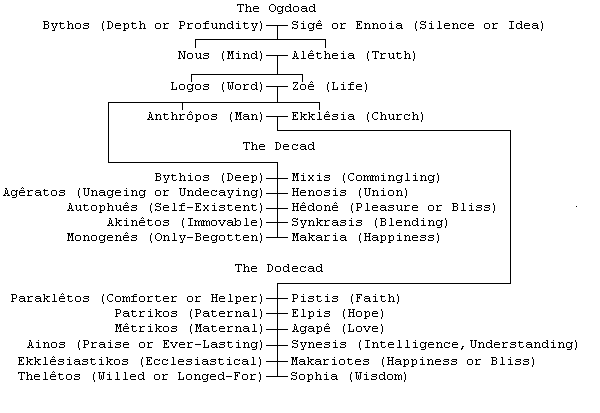
2. The Holy Father emanated 30 odd Aeons in pairs of syzgies and held their perfection with in himself and did not gave it to them. Its not that the Holy Father is jealous because what jealousy could there be between him and his Aeons. The Holy Father wishes that his Aeons love him and return to him so that they can end their wearying search for the Father and come to rest with him and there by receive their perfection. The Aeons exist inside the womb of the Father and emanate from him and yet they do not recognize or perceive the One in whom they were.

                 The Thirty Aeons of the Pleroma emanated by the Holy Father


3. Sophia, the last of the Aeons wishes to know the Father and her passion to know the Father grows and she commits an error.

4. The bad elements emanating from Sophia is combined to form Achamoth (also called Lower Sophia) and she is cast out of the Pleroma as her existence inside it destabilizes the equilibrium of the Pleroma.

5. Achamoth sheds her tears and wish to return to the Pleroma.

6. With the permission of the Father the Aeons emanate an another pair of zygies (Aeon pairs) namely Christos and the Holy Spirit to save Achamoth.

7. Christos and the Holy Spirit emanate Christ - The common fruit of the Pleroma.

8. Christ, the Saviour receives a part of light from every Aeon in the Pleroma and therefore In Christ dwells all the fullness of the deity in bodily form.

9. Christ, the Saviour orders Achamoth to bring forth the Demiurge, the God of the Jews or Jehovah because the spiritual seeds produced from their union needed a place for it to grow.

10. Human beings are the breeding ground for the seeds of Achamoth, the Lower Sophia and hence the Valentinians had a very positive attitude towards procreation and marriage.

11. The Demiurge, the God of the Jews having created the earth and the heavens said that I am God and there is no God before me due to his stubborn ignorance without knowing that all along he was indirectly guided by Achamoth who secretly sown the spiritual seed in every human being.

12. The Demiurge, the God of the Jews is the Father of the Devil. Yes, the devil has a father and it is none other than Jehovah.

13. The Devil, the liar and his evil Archons rule this earth and they occupy the heart of men making them vulnerable to sin and drive men away from the truth.

14. The Demiurge sends his son Jesus as the messiah of the Jews to proclaim his message and to fulfil the prophecy of the Prophets.

15. Christ, the Saviour descends onto the body of Jesus in the form of a dove when he was baptized by John the Baptist and as soon as Jesus raised from the Holy water he showed contempt to this world and laughed at this imperfect creation which was modelled according to the Pleroma above.

16. Jesus used to often kiss Mary Magdalene on her mouth and she was probably his companion. Jesus loved Mary more than the rest of the Apostles and silenced Peter who always objected to Mary's leadership during the early times of the church. The Saviour offered a way for women too to enter into heaven.

17. Judas Iscariot was the only one who truly understood the Saviour and Christ ordered Judas to hand him over to the Romans so that Christ could finally be freed from his material bondage with Jesus.

18.  The Saviour, possessing a spiritual body did not suffered at the cross and was mocking at the Pharisees by sitting on the branch of a tree. The Pharisees did not knew whom they were piercing with.

19. God, the Demiurge took the soul of Jesus and he will stand at the right hand of God till the end of times.

20. The Saviour then resurrected the body of Jesus and appeared to Mary first in the form of a vision and to the rest of the Apostles. The Saviour came back only in the likeness of the flesh and the Valentinians did not believed in bodily resurrection.

21. The Saviour appeared to Saint Paul on the road of Damascus and gave him the Pleromic revelation, the greatest mystery ever revealed to mankind. The Saviour chose Paul to take the good news of the Gospel to the Gentile nations and hence he was called as the Apostle to the Gentiles. The Saviour also appeared to Valentinus in the form of a vision of a young child and after few years ascended back to the Pleroma.

22. Therefore there is one Pneumatic Christ at the Pleroma level and there is an another psychic Christ who is the son of the Demiruge, the God of the Jews at the Kenoma level.

23. The psychic Christ is the one whom the Roman Catholics worship and they too will receive a lower salvation in the end.

24. The Pneumatics are those who have a pure heart and they are preordained to be saved by their nature and not by works of the Law. The Pneumatics cannot sin because God's very nature is in them. The Pneumatics cannot boast about anything no matter what and they have to be humble, strong and lead a sinless existence with the help of gnosis which they have received from the Pneumatic Christ.

25. The Psychics on the other hand do have free will and depending on their works of the Law they either chose to give their heart to the Demiurge or to the Devil.

26. The Hylics namely atheists are the sons of devil and these Hylics who worship matter which is evil will perish along with it at the end of the cosmos.

27. The Demiurge, the God of the Jews is the Centurion described in the Bible who will run towards Christ during the end times when he realizes the One who brought forth him into existence.

28. The Pneumatics perform the Bridal Chamber ritual which is holy of the holiest and unite with their angelic counterparts in the Pleroma.

29. The Roman Catholics, the Protestants, the Mormons and other countless sects of Christianity who are lower Christians will wait with the Demiurge till the end times and they too will return to the Pleroma and receive their angelic counterparts and join the common feast of the Pleroma. So the only difference between the Pneumatics and Psychics is only in the timing of their redemption. The Pneumatics redeem themselves here and now with the help of gnosis and unmerited grace and the Psychics on the other hand are saved by blind faith and by the works of the Law.

30. Everything happens according to the will of the Father and no one can receive gnosis without Faith.


Friday, 9 January 2015

Dr. Einar Thomassen speaks on Valentinus and the Valentinian tradition


Dr. Einar Thomassen is the author of the book The Spiritual Seed: The Church of the Valentinians and he is the first gnostic scholar apart from Elaine Pagels to have made a succinct formulation of the Valentinian system. His doctoral research was made on Tripartite Tractate, a Valentinian text which fully describes the Valentinian view of the cosmos. I really don't have to say anything else as Einar Thomassen has beautifully described our doctrine with his own words and I have nothing to object.

I would just like to add that if there is any Valentinian text that I would always like to keep it with me till my death then it will be the Gospel of Truth. In fact Einar Thomassen said in an another interview, "Not every time he (Valentinus) sat down to write a Gospel (Gospel of Truth) where he was going to throw in all the cosmology, cosmogony and the theogony." If anyone wants to understand the Valentinian system I would highly recommend reading Gospel of Truth because it was probably written by the great Valentinus himself. 

Saint Paul was a Gnostic and the Valentinians were the great Paulinists and what better proof for this theory than the work of Elaine Pagels, The Gnostic Paul. Christ will never ever forgive those who persecuted the Valentinian Christians. But as Valentinus himself says we should not take error too seriously because all the evil that humans commit in this world is because they are ignorant of the Father and gnosis is the only way to end human suffering and evil in this world but to receive gnosis you need faith. "No one can receive gnosis without faith." (Gospel of Philip)

While I write this my heart bleeds at the way that these sensitive Christians were burnt alive by the so called orthodox church authorities.

Sunday, 14 December 2014

Saint Paul, the great doctor of the church was himself a Gnostic


As a Valentinian Christian I have no doubt whatsoever that Saint Paul, the great doctor of the church was himself a Gnostic and I don't like any criticisms against him. I also don't agree with the conclusion of the video which says Christianity and Saint Paul was influenced by other pagan mysteries like Isis and Serapis. No, Saint Paul truly received the highest pleromic revelation from the pneumatic Christ who resides in the Pleroma. I literally believe in the Valentinian myth of Sophia and it is not just a myth but it is more real than ordinary reality. Pauline Christianity was indigenous and was not influenced by any other pagan mystery religions.

I also believe that the Pastoral Epistles like Timothy 1 and Timothy 2 were fake letters in the name of Saint Paul and should be immediately dropped from the Biblical Canon. I for one just skim away any verses cited from the Pastoral Epistles because they were not divinely inspired and they were not written by Saint Paul.

Thursday, 16 October 2014

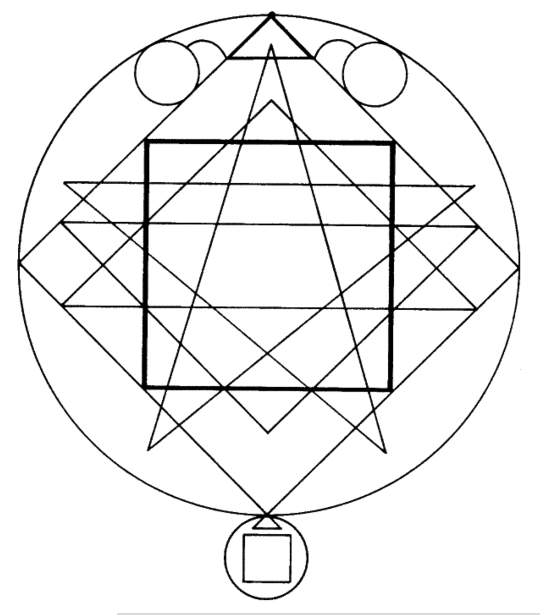
Symbolic representation of Pleroma


First the • (Point), the Monad, Bythus (the Deep), the unknown and unknowable Father. Then the Δ (Triangle), Bythus and the first emanated pair or Duad, Nous (Mind) and its syzygy Aletheia (Truth). Then the □ (Square), the dual Duad, Tetractys or Quaternary, two males ||, the Logos (Word) and Anthrôpos (Man), two females, their syzygies, = Zoê (Life) and Ekklesia (the Church or Assembly), Seven in all. The Triangle the Potentiality of Spirit, the Square the Potentiality of Matter; the Vertical Straight Line the Potency of Spirit, and the Horizontal the Potency of Matter. Next comes the Pentagram ⋆, the Pentad, the mysterious symbol of the Manasáputras or Sons of Wisdom, which together with their syzygies make 10, or the Decad; and last of all, the Hexalpha or interlaced Triangles ✡ the Hexad, which with their syzygies make 12, or the Dodecad. Such are the Contents of the Pleroma or Completion, the Ideas in the Divine Mind, 28 in all, for Bythus or the Father is not reckoned, as it is the Root of all. The two small circles within the Pleroma are the syzygy Christos-Pneuma (Christ and the Holy Spirit); these are after-emanations, and, as such, from one aspect, typify the descent of Spirit to inform and evolve Matter, which essentially proceeds from the same source . . . The Circle of the Pleroma is bounded by a circumference emanated from Bythus (the Point), this is called the Horus (Boundary), Staurus (Stock, Stake, or Cross) and Metæcheus (Participator); it shuts off the Pleroma (or Completion) from the Hystêrema (the Inferiority or Incompletion), the larger from the smaller Circle, the Unmanifested from the Manifested. Within the Circle of the Hysterêma is the Square of primordial Matter, or Chaos, emanated by Sophia, called the Ektrôma (or Abortion). Above this is a Triangle, primordial Spirit, called the Common Fruit of the Pleroma, or Jesus, for to all below the Pleroma it appears as a unity. Notice how the Triangle and Square of the Hysterêma are a reflection of the Triangle and Square of the Pleroma. Finally, the plane of the paper, enclosing and penetrating all, is Sigê (Silence). 


— G.R.S. Mead & H.P. Blavatsky

This symbolism truly represents the doctrine of Valentinians and the Vedic Aryans that this world was created by the demiurge which is modelled based on the real Pleromic world. The symbol is allegorical and should not treated as a literal representation of the Pleroma. This symbol unites the Valentinian tradition with the Shukla Yajurveda tradition and I have this symbol on my car's rear window which truly represents our gnostic doctrine unifying both the traditions who want to send out the same message to the world.


Monday, 2 June 2014

The secret Pauline mystery tradition of the Valentinians

Saint Paul, the Apostle to the Apostles.

Saint Paul was the apostle to the apostles because he and Valentinus were the only ones who had truly received the highest Pleromic revelation of Christ possible. The post resurrected Jesus of Matthew, Mark, John, Luke, Mary, Peter, Thomas, Judas, James and others revealed to Saint Paul a mystery which was hidden for ages and this mystery allowed the impossible that is the salvation to both Jews and the Gentiles. The good news of Saint Paul.

Romans 1:16 For I am not ashamed of this Good News about Christ. It is the power of God at work, saving everyone who believes--the Jew first and also the Gentile.

I dare not ask why God chose to reveal this mystery to Saint Paul and not to the other apostles perhaps he was the chosen one. He never met the human Jesus who walked on earth along with the other twelve apostles but so what, all the apostles did saw the post resurrected Jesus and hence all the apostles including Saint Paul are even in that context.

Both Saint Paul and Valentinus truly received the highest Pleromic revelation.

Perhaps no man in the history of the world has been so brutally attacked for speaking the truth other than Saint Paul, the Jews hated him because he undermined the Jewish Law and hated him for a number of other reasons, the Greeks saw him as a charlatan who was trying to seduce the pagans to Christianity, the Ebionites said that he converted to Judaism just to win the daughter of a Jewish priest, most Christians accuse him as being the culprit to twist the doctrine of Jesus, the academic people consider him to be an epileptic patient, scholars who know the truth are silent and don't come out and speak out the truth about Saint Paul.

Oh that's just great you morons isn't it, you all have failed to understand the pneumatic heart of one man, Saint Paul, its time to set those accusations straight and give him the reverence which he truly deserves.

What's the proof? From Saint Paul to Valentinus, one vision, one doctrine.

For in Christ dwells all the Aeons of the pleroma in bodily form (Colossians 2:9)

It was quite amazing that Aeons were in the Father and that they were able to emanate in as much as they were not able to perceive and recognize the one in whom they were. (Gospel of Truth)

This kind of knowledge and conviction can only come from revelation not by book reading or not by being influenced by other mystery schools and not by making up things on your own by wishful thinking. If it was all made up then why is that Saint Paul and a century later Saint Valentinus are adamant about their doctrine of Christ. Saint Paul never met Jesus and Valentinus never met Saint Paul  and yet our mode of communication is only one thing i.e. Gnosis Kardias.

Ptolemy in his letter to Flora says that we too have received the apostolic tradition and there is a continuity of tradition from Saint Paul to Valentinus and to Valentinians and only those who have knowledge of the tradition really know what a great doctrine Saint Paul is preaching in his Gospel and not some moron who writes rubbish about Saint Paul.

Saint Paul just like the Valentinians considered himself to be outside the Law because the original Law is already written in the hearts of the pneumatics and hence they do not sin by nature.

1 Corinthians 9 To the Jews I became as a Jew, so that I might win Jews; to those who are under the Law, as under the Law though not being myself under the Law, so that I might win those who are under the Law; to those who are outside the law, as outside the law, though not being outside the law of God but under the law of Christ, so that I might win those who are outside the law. To the weak I became weak, that I might win the weak; I have become all things to all men, so that I may by all means save some.…

Romans 2:15 For when Gentiles who do not have the Law do instinctively the things of the Law, these, not having the Law, are a law to themselves, in that they show the work of the Law written in their hearts, their conscience bearing witness and their thoughts alternately accusing or else defending them, on the day when, according to my gospel, God will judge the secrets of men through Christ Jesus.

Neither Jew nor Gentile but a Gnostic who is one with Christ.

Galatians 3:28 There is neither Jew nor Gentile, neither slave nor free, nor is there male and female, for you are all one in Christ Jesus.

Valentinians are the real Pauline Christians and we are back. A tradition without its rituals is as good as dead but the fact that our entire philosophical setting which is based on Paul's Pleroma Theology is intact and rock solid even at this current age and time is enough to make us believe in the pneumatic Christ and return back to the Pleroma where we came from, which is the abode of the Aeons.

Valentinianism is going to stay and its tradition will raise back from India because in this part of the world this religion is the orthodoxy and we absolutely love it.

Tuesday, 29 April 2014

The Valentinian view on resurrection.

          As a Valentinian gnostic I seriously impugn the resurrection of the flesh because what is perishable cannot enter the domain of the imperishable. What is not real cannot enter the domain of the real.
"Do not think that the resurrection is an illusion, it is not an illusion in fact one ought to maintain the world is an illusion rather than resurrection." 
- Treatise on Resurrection

Pleroma, Kenoma and the Cosmos

If you want to enter the Pleroma then you must resurrect while you are alive, here and now. This is the true resurrection, the spiritual resurrection. Baptism leads to resurrection and redemption.
"Those who think that they will die first and then rise are in error, if they do not receive the resurrection while they live, when they die they receive nothing"  
- Gospel of Philip
If you want to enter the Kenoma then you must have faith in the psychic Jesus, the son of the demiurge and wait until his second coming and then enter the Kenoma.
"For God so loved the world, that he gave his only begotten Son, that whosoever believeth in him should not perish, but have everlasting life. "
John 3:16
If you neither want to enter the Pleroma nor the Kenoma then be an atheist and perish with the cosmos.

Neither in Pleroma nor in the Kenoma the corpus body can enter. Well some might say that people have ascended to heaven alive with their physical bodies. Entering heaven alive is very much possible, I am not denying that fact, what I am saying is that at some point to enter the heavens of the Kenoma one must give up their physical bodies and wear their spiritual bodies.
"It is sown a natural body; it is raised a spiritual body. There is a natural body, and there is a spiritual body." 
- 1 Corinthians 15:44

We divide the human Jesus from the divine Savior 

The Savior descended from the Pleroma in the form of a dove and entered the body of human Jesus at the time of his baptism and flew out of his body at the time of his crucifixion.
"As soon as Jesus was baptized, he went up out of the water. At that moment heaven was opened, and he saw the Spirit of God descending like a dove and alighting on him." 
- Matthew 3:16
The Savior sometimes spoke for the Pleroma and for his Father and sometimes spoke for the Kenoma and for the Jesus's Father, the Demiurge. This is the reason why the scriptures are ambiguous and truth cannot be extracted from them by those who are ignorant of tradition.

The Savior then raised the carnal psychic body of Jesus from death and taught the gnosis of the Father to his disciples and returned to the Pleroma, above the heaven of Sophia. The Savior indeed saved the world not by dying at the cross for our sins for we are not sinners from the beginning but the children of the Father of Truth but by imparting the gnosis of the Father he saved the world from the rulers of this world.
“Certainly they confess with their tongues the one Jesus Christ, but in their minds they divide him.”
          - Irenaeus

Our entire theology is based on Christology and we speak not on the basis of scriptures or on the basis of our intellect but we solely speak on the basis of revelation that we possess, it trumps logic, reason and just about everything, the pneumatic Christ contains with in him all the Aeons of the pleroma bodily, he will never ever cover his body with the hylic material substance. Its foolish to think the 'Word became flesh' literally, instead it means the Savior entered the body of human Jesus and suffered all the emotive feelings that the human body of Jesus went through from the time of his baptism to the time of his death at the crucifixion. Our docetic theology is a consequence of the very nature of Christ and the substance which form his body.

Role of Jesus in Valentinianism

Saturday, 12 April 2014

The Bridal Chamber in Gospel of Philip should be interpreted allegorically and spiritually.

Gospel of Philip is an highly esoteric Gospel and it is in this Gospel that the words Bridal Chamber is more frequently used. However some of them like the Latter Day Saints or the Mormon Church, Dan Brown and others have interpreted this sacrament sexually going so far as claiming that there existed a literal Bridal Chamber with the bride and the bridegroom which is completely in variance with the theme of Gospel of Philip.

Gospel of Philip is a Valentinian material, a Valentinian exposition and in such context the entire Gospel of Philip should be interpreted around the 'Fall of Sophia' myth and the restoration of fullness which takes place when the Saviour descends on earth to teach everyone the gnosis of the unbegotten Father. So the union in the Bridal Chamber is not something which takes place between an earthly bride and the bridegroom instead it is a union which takes place between the Holy Father and the individual who enters into the Bridal Chamber.

Gospel of Philip clearly slaps on their faces to all those who interpret the sacrament of Bridal Chamber sexually and literally which is a clear misunderstanding on their part showing a shear lack of gnosis.

No one can know when the husband and the wife have intercourse with one another, except the two of them. Indeed, marriage in the world is a mystery for those who have taken a wife. If there is a hidden quality to the marriage of defilement, how much more is the undefiled marriage a true mystery! It is not fleshly, but pure. It belongs not to desire, but to the will. It belongs not to the darkness or the night, but to the day and the light. If a marriage is open to the public, it has become prostitution, and the bride plays the harlot not only when she is impregnated by another man, but even if she slips out of her bedroom and is seen. Let her show herself only to her father and her mother, and to the friend of the bridegroom and the sons of the bridegroom. These are permitted to enter every day into the bridal chamber. But let the others yearn just to listen to her voice and to enjoy her ointment, and let them feed from the crumbs that fall from the table, like the dogs. Bridegrooms and brides belong to the bridal chamber. No one shall be able to see the bridegroom with the bride unless he become such a one.
         - Gospel of Philip

The author of Gospel of Philip clearly says that the marriage which takes place in the Bridal Chamber is not fleshly but pure, it is not the defiled marriage between an earthly bride and the bridegroom but an undefiled marriage between the Holy Father and the individual who receives the light.

I don't know what stupidity in them makes them think that the sacrament of Bridal Chamber is equivalent to the defiled earthly marriage, as a Valentinian Gnostic I am least concerned of the historical Jesus, I do not care whether he was married to Mary Magdalene or not, I am least interested to know his bloodline. What we are more interested is in the pneumatic Christ, the Christ in you and his acquaintance.

Thanks to this psychic world for completely missing the esoteric pleromic interpretation of the Gospel of Philip, who though hearing the mysteries of the kingdom of heaven do not hear and who though seeing they do not see and are more concerned with the earthly rather than the spiritual abode of Aeons.


Monday, 31 March 2014

Pistis Sophia cannot be the work of Valentinians

The work of Pistis Sophia is in more accordance with Ophites rather than with Valentinianism. Scholars have rightly abandoned the hypothesis that Pistis Sophia might be a Valentinian material.

Why do I think it is not a Valentinian material?

The reason being the concept or the role of demiurge in Pistis Sophia, almost more than 5 times the self willed Yaldabaoth tries to oppress Sophia who had fallen from her original 13th heaven and tries to take away all her light, compare this with the Tripartite Tractate of the Valentinians, it clearly says,


"The Logos uses him(Yaldabaoth or Demiurge) as a hand, to beautify and work on the things below, and he uses him as a mouth, to say the things which will be prophesied."
         - Tripartite Tractate

The role of demiurge in Valentinianism is quite unique among the gnostic sects, here he is not seen as a demon or as an oppressor of Sophia instead he is seen as an ignorant God who doesn't know about the higher pleromic Aeons. Sophia uses him secretly to sow the spiritual seed in all human beings, that's why this world even though its not real is very important, this is the reason why the Valentinians had such a positive attitude towards pro-creation, marriage and in creation overall.

With all being said Pistis Sophia is an extraordinary work and a must read for all those who have a love for the gnosis of the heart.


Thursday, 27 March 2014

The entire Basilidian system and the more refined Valentinian system is Brahmanical in its origin.

Mosheim, the first historian of the church long maintained that the roots of Christian Gnosticism is not to be found in the religion of the Greeks or either in the Zoroastrianism of the Persians instead Christian Gnosticism is derived in its entirety from the religion of the Brahmans.

When one studies the ontology of the Ineffable Father of these two religions there is no doubt in my mind that they both are expressing the same Ineffable Father. In both of these traditions the totality of divine powers or Aeons resided in the womb of Father from the very beginning of creation.

"Hiranyagarbha - One who dwells in the womb (garbha) of the world (Hiranya). The Hiraṇyagarbha SÅ«kta of the á¹škveda declares that God manifested Himself in the beginning as the Creator of the Universe, encompassing all things, including everything within Himself, the collective totality, as it were, of the whole of creation, animating it as the Supreme Intelligence."

        - Hiranyagarbha

"On the other hand, the treatise also contains elements that point toward an early phase of Valentinian theology, like the theory that the aeons initially existed inside the Father as in a womb--a theory also attested for Valentinus himself (Tertullian, Against the Valentinians 4.3) and found in the Gospel of Truth."

        - Einar Thommassen  on Tripartite Tractate
  

Abraxas is the Holy Father of the gnostics and this unique image of him riding a chariot clearly proves that he is a supreme deity belonging to the solar pantheon. 


                                                 From: C.W. King's Gnostics and their remains

Carl Jung is right, Abraxas is a god whom humanity have forgotten. Don't be carried away by the symbolism of the Basilidians I strongly doubt that the symbolism has anything to do with the Ineffable Father's ontology or his appearances. The irony is, what is orthodoxy in one part of the world is totally heretical on the other side. Its a knowledge which the west have rejected.


Sunday, 29 September 2013

Localization of the Pleroma: Where do the Gnostics stand?

If anyone had carefully read my posts I repeatedly assert that Pleroma has a local existence, what do I mean by that? Well, if you have read "On the meaning of the Pleroma" by J.B Lightfoot you would probably get an idea as to from where I'm coming from. I did gave a link in an another post to this work but I think most of them do not care to read it.

Thanks to J.B Lightfoot,
-------------------------------------------------------------------------------------------------------------------------------------------------------------------------------------------------------------------------------------------------------------

On the meaning of the word Pleroma

"When we turn from Catholic Christianity to the Gnostic sects we find this term used, though (with one important exception) not in great frequency. Probably however, if the writings of the earlier Gnostics had been preserved, we should have found that it occupied a more important place than at present appears. One class of early Gnostics separated the spiritual being Christ from the man Jesus ; they supposed that the Christ entered Jesus at the time of His baptism and left him at the moment of His crucifixion. Thus the Christ was neither born as a man nor suffered as a man. In this way they obviated the difficulty, insuperable to the Gnostic mind, of conceiving the connexion between the highest spiritual agency and gross corporeal matter, which was involved in the Catholic doctrine of the Incarnation and Passion, and which Gnostics of another type more effectually set aside by the theory of docetism, i.e. by assuming that the human body of our Lord was only a phantom body and not real flesh and blood.

Irenaeus represents the former class as teaching that 'Jesus was the receptacle of the Christ', and that the Christ 'descended upon him from heaven in the form of a dove and after He had declared (to mankind) the nameless Father, entered (again) into the pleroma imperceptibly and invisibly. Here no names are given. But in another passage he ascribes precisely the same doctrine, without however naming the pleroma, to Cerinthus. And in a third passage, which links together the other two, this same father, after mentioning this heresiarch, again alludes to the doctrine which maintained that the Christ, having descended on Jesus at his baptism, 'flew back again into His own pleroma' In this last passage indeed the opinions of Cerinthus are mentioned in connexion with those of other Gnostics, more especially the Valentinians, so that we cannot with any certainty attribute this expression to Cerinthus himself. But in the first passage the unnamed heretics who maintained this return of the Christ 'into the pleroma are expressly distinguished from the Valentinians ; and presumably therefore the allusion is to the Cerinthians, to whom the doctrine, though not the expression, is ascribed in the second passage. Thus there seems to be sufficient reason Connexion for attributing the use of the term to Cerinthus This indeed is probable of this use on other grounds. The term pleroma, we may presume, was common to St Paul and the Colossian heretics whom he controverts. To both alike it conveyed the same idea, the totality of the divine powers or attributes or Colossiaa agencies or manifestations. But after this the divergence begins. The heretics, maintained that a single divine power, a fraction of the pleroma, resided in our Lord : the Apostle urges on the contrary, that the whole pleroma has its abode in Him-. The doctrine of Cerinthus was a development of the Colossian heresy, as I have endeavoured to show above. He would therefore inherit the term pleroma from it. At the same time he seems to have given a poetical colouring to his doctrine, and so doing to have treated the pleroma as a locality, a higher spiritual region, from which this divine power, typified by the dove-like form, issued forth as on wings, and to which, taking flight again, it reascended before the Passion. If so, his language would prepare the way for the still more elaborate poetic imagery of the Valentinians, in which the pleroma, conceived as a locality, a region, an abode of the divine powers, is conspicuous.

The attitude of later Gnostics towards this term is widely divergent. The term The word is not, so far as I am aware, once mentioned in connexion with avoided by the system of Basilides. Indeed the nomenclature of this heresiarch, longs to a wholly different type ; and, as he altogether repudiated the doctrine of emanations*, it is not probable that he would have any fondness for a term which was almost inextricably entangled with this doctrine.

On the other hand with Valentinus and the Valentinians the doctrine of the pleroma was the very key-stone of their system; and, since at first in sight it is somewhat difficult to connect their use of the term with St Paul's, a few words on this subject may not be out of place.

Valentinus then dressed his system in a poetic imagery not unlike the myths of his master Plato. But a myth or story involves action, and action requires a scene of action. Hence the mysteries of theology and cosmogony and redemption call for a topographical representation, and the pleroraa appears not as an abstract idea, but as a locality.

Topogra- The Valentinian system accordingly maps out the universe of things great regions, called respectively the pleroma and the kenoma, the 'fulness' and the 'void'. From a Christian point of view these may be described as the kingdoms of light and of darkness respectively. From Antithesis the side of Platonism, they are the regions of real and of phenomenal of pleroma existences — the world of eternal archetypes or ideas, and the world of material and sensible things. The identification of these two antitheses was rendered easy for the Gnostic ; because with him knowledge was one with morality and with salvation, and because also matter was absolutely bound up with evil. It is difficult to say whether the Platonism or the Christianity predominates in the Valentinian theology ; but the former at all events is especially prominent in their conception of the relations between the pleroma and tlie kenoma. The pleroma is the abode of the AEons, who are thirty in number. These AEons are successive emanations, of which the first pair sprang immediately from the pre-existent Bythus or Depth. This Bythus is deity in itself, the absolute first principle, as the name suggests ; the profound, unfathomable, limitless, of whom or of which nothing can be predicated and nothing known. Here again we have something like a local representation. The AEons or emanations are plainly the attributes and energies of deity ; they are, or they comprise, the eternal ideas or archetypes of the Platonic philosophy. In short they are deity relative, deity under self-imposed limitations, deity derived and divided up, as it were, so as at length to be conceivable.

The topographical relation of Bythus to the derived AEons was differently given in different developments of the Valentinian teaching. According to one representation he was outside the pleroma; others placed his abode within it, but even in this case he was separated from the rest by Horus {"Opos), a personified Boundary or Fence, whom none, not even the AEons themselves, could pass^ The former mode of representation might be thought to accord better with the imagery, at the same time that it is more accurate if regarded as the embodiment of a philosophical conception. Nevertheless the latter was the favourite mode of delineation; and it had at least this recommendation, that it combined in one all that is real, as opposed to all that is phenomenal. In this pleroma every existence which is supra-sensual and therefore true has its abode.

Separated from this celestial region by Horus, another Horus or Kerwma, Boundary, which, or who, like the former is impassable, lies the ' kenoma ' the region or void '—the kingdom of this world, the region of matter and material things, the land of shadow and darkness Here is the empire of the Demiurge or Creator, who is not a celestial Man at all, but was born in this very void over which he reigns. Here reside all those phenomenal, deceptive, transitory things, of which the eternal counterparts are found only in the pleroma.

It is in this antithesis that the Platonism of the Valentinian theory Platonism reaches its climax. All things are set off one against another in these two of this antithesis.

The swan on still St Mary's lake
Floats double, swan and shadow.

Not only have the thirty AEons their terrestrial counterparts; but their subdivisions also are represented in this lower region. The kenoma too has its ogdoad, its decad, its dodecad, like the pleroma. There is one Sophia in the supra-mundane region, and another in the mundane; there is one Christ who redeems the AEons in the spiritual world, and a second Christ who redeems mankind, or rather a portion of mankind, in the sensible world. There is an Aeon Man and another Aeon Ecclesia in the celestial kingdom, the ideal counterparts of the Human Race and the Christian Church in the terrestrial. Even individual men and women, as we shall see presently, have their archetypes in this higher sphere of intelligible being.

The localisation of the plerOma carried out in detail. 

The topographical conception of the pleroma moreover is carried out in the details of the imagery. The second Sophia, called also Achamoth, is the desire, the offspring, of her elder namesake, separated from her mother, cast out of the pleroma, and left ' stranded ' in the void beyond^, being prevented from returning by the inexorable Horus who guards the frontier of the supra-mundane kingdom. The second Christ — a being compounded of elements contributed by all the AEons— was sent down from the pleroma, first of all at the eve of creation to infuse something like order and to provide for a spiritual element in this lower world ; and secondly, when He united Himself with the man Jesus for the sake of redeeming those who were capable of redemption^. At the end of all things Sophia Achamoth, and with her the spiritual portion of mankind, shall be redeemed and received up into the pleroma, while the psychical portion will be left outside to form another kingdom under the dominion of their father the Demiurge. This redemption and ascension of Achamoth (by a perversion of a scriptural image) was represented as her espousals with the Saviour, the second Christ; and the pleroma, the scene of this happy union, was called the bridal-chamber Indeed the localisation of the pleroma is as complete as language can make it. The constant repetition of the words * within * and 'without', 'above' and 'beneath', in the development of this philosophical and religious myth still further impresses this local sense on the term^.

In this topographical representation the connexion of meaning in the word pleroma as employed by St Paul and by Valentinus respectively seems at first sight to be entirely lost. When we read of the contrast between the pleroma and the kenoma, the fullness and the void, we are naturally reminded of the plenum and the vacuum of physical speculations. The sense of pleroma, as expressing completeness and so denoting the aggregate or totality of the Divine powers, seems altogether to have disappeared. But in fact this antithesis of Keuwfia was, so far as we can make out, a mere afterthought, and appears to have been borrowed, as Irenaeus states, from the physical theories of Democritus and Epicurus^. It would naturally suggest itself both because the opposition of ifK-qpr^s and K€vos was obvious, and because the word Kevcofia materially assisted the imagery as a description of the kingdom of waste and shadow. But in itself it is a false antithesis. The true antithesis appears in another, and borrowed probably an earlier, term used to describe the mundane kingdom.

In this earlier representation, which there is good reason for ascribing to Valentinus himself, it is called not Kevafia ' the void', * the deficiency, incompleteness '1. Moreover the common phraseology of this appears in Valentinian schools shows that the idea suggested by this opposition to theirs was not the original idea of the term. They speak of the whole aggregate of the AEons. And this (making allowance for the personification of the Aeons) corresponds exactly to its use in St Paul.

Again the teaching of the Valentinian schools supplies other uses which serve to illustrate its meaning. Not only does the supra-mundane kingdom as a whole bear this name, but each separate AEon, of which that shown kingdom is the aggregation, is likewise called a pleroraa This designation is given to an AEon, because it is the fullness, the perfection, of which its mundane counterpart is only a shadow and defective copy. Nor does the narrowing of the term stop here. There likewise dwells in this higher region a pleroma, or eternal archetype, not only of every comprehensive mundane power, but of each individual man; and to wed himself with this heavenly partner, this Divine ideal of himself, must be the study of his life. The profound moral significance which underlies the exaggerated Platonism and perverse exegesis of this conception will be at once apparent.

But the manner in which the theory was carried out is curiously illustrated by the commentary of the Valentinian Heracleon on our Lord's discourse with the Samaritan woman"*. This woman, such is his explanation, belongs to the spiritual portion of mankind. But she had had six husbands, or in other words she laid entangled herself with the material world, had defiled herself with sensuous things. The husband however, whom she now has, is not her husband; herein she has spoken rightly: the Saviour in fact means 'her partner from the pleroma'. Hence she is bidden to go and call him ; that is, she must find ' her pleroma, that coming to the Saviour visit him (or it), she may be able to obtain from Him the power and the union and the combination with her pleroma' {rfiv bvvap.iv Koi TTjv evcocriv koI ttjv avaKpacriv rffv Trpbs to irKr^papa avTTjs), * For', adds Heracleon, ' He did not speak of a mundane {KoaptKov) husband when He told her to call him, since He was not ignorant that she had no lawful husband'.

Impossible as it seems to us to reconcile the Valentinian system with the teaching of the Apostles, the Valentinians themselves felt no such difficulty. They intended their philosophy not to supersede or contradict Apostolic doctrine, but to supplement it and to explain it on philosophical principles. Hence the Canon of the Valentinians comprehended the Canon of Catholic Christianity in all its essential parts, though some Valentinian schools at all events supplemented it with Apocryphal writings. More particularly the Gospel of St John and the Epistles to the Colossians and Ephesians were regarded with especial favour; and those passages which speak of the pleroma are quoted more than once in their writings to illustrate their teaching. By isolating a few words from the context and interpreting them wholly Without reference to their setting, and quote they had no difficulty in finding a confirmation of their views, where we see them in only an incongruity or even a contradiction. For instance, their second Christ — the redeemer of the spiritual element in the mundane world — was, views. as we saw, compacted of gifts contributed by all the Aeons of the pleroma. Hence he was called ' the common fruit of the pleroma', ' the fruit of all the pleroma'^, 'the most perfect beauty and constellation of the pleroma; hence also he was designated 'All' (natf) and 'All things' (navTay.

Accordingly, to this second Christ, not to the first, they applied these texts; Col. iii. 11 * And He is all things', Rom. xi. 36 'All things are unto Him and from Him are all things'. Col. ii. 9 ' In Him dwells all the fulness of the Godhead', Ephes. i. 10 ' To gather together in one all things in Christ through God '2. So too they styled him EvdoKrjTos, with a reference to Col. i. 19, because 'all the pleroma was pleased through Him to glorify the Father'^ And inasmuch as this second Christ was according to the Valentinian theory instrumental in the creation of the mundane powers, they quoted, or rather misquoted, as referring to this participation in the work of the Demiurge, the passage Col. i. 16 ' In Him were created all things, visible and invisible, thrones, deities, dominions'*. Indeed it seems clear that these adaptations were not always afterthoughts, but that in several instances at least their nomenclature was originally chosen for the sake of fitting the theory to isolated phrases and expressions in the Apostolic writings, however much it might conflict with the Apostolic doctrine in its main lines°. "


--------------------------------------------------------------------------------------------------------------------------------------------------------------------------------------------------------------------------------------------------------------
Saint Paul was right, all the pleroma(totality of divine powers or Aeons) of deity(Father) dwells in Christ and form his body and moreover this pleroma has a local existence, it locally exists just as it is said in the Gospel of Thomas - "The kingdom of God is spread out upon earth but men don't see it".

As anyone can see Christ is at the very heart of the doctrine of Valentinian theology it is ridiculous to assert that there is no special place for Christ in Valentinian theology or in gnosticism as a whole. Christ is at the very soul of their doctrine.