Showing posts with label Comparative Religion. Show all posts

Thursday, 25 November 2021

The Problem of Evil in Zurvanism and Hinduism

Zurvan willed to have a son and sacrificed for nine hundred and ninety nine years but nothing happened and he started to doubt the efficacy of his sacrifice and the moment this thought arises in his mind an egg will come into existence and to his surprise the egg or the womb contains a twin. One of them is Ohrmazd, the good god who is the result of his sacrifice and another one was Ahriman who is the result of his doubt on the efficacy of his sacrifice.

Isn't the tendency to doubt a common nature of human beings? I think this nature has come down to us from our Father Zurvan. Even I used to offer sacrifices to the Savitr God, twice a day, once in the morning and in the evening for one whole year and I started doubting these sacrifices. I thought what knowledge have I gained by doing this for one whole year? After these thoughts came to mind unfortunately I fell unconscious forward in the morning and backward in the evening while I was doing sun salutations. Isn't this tendency to doubt things a common nature of human beings? Now you can imagine how Zurvan might have felt after sacrificing for nine hundred and ninety nine years, day after day and yet nothing happened. This is the reason why Zurvan said this to his son, Ohrmazd, "Up until now I have offered sacrifices to you and now you will sacrifice to me".

The intention of God was indeed to create a perfect world with no suffering and evil but he messed up big time with his experiment and this resulted in a world with both good and evil. Its like the gain of function experiments, though the intention is to do something good for the world but if things go wrong then the same gain of function can create havoc in the entire world and what better example than the gain of function experiments on Corona Viruses.

Hinduism has no concept of devil and all events are attributed as fate by God. How can rape and murder be part of the divine plan? How can you convince a women that something better is in store for her when she is brutally raped by someone and this is all part of the divine plan? If we have to believe that she got raped for something she did in her previous lives then why the hell God is not showing what we have done in our previous lives? Why is that hidden? How are we supposed to learn from our mistakes in previous lives if we are not even aware of why we are suffering in this life? This whole theory of karma sucks. For people like me who believe we have no free will whatsoever it makes no sense whatsoever. Foolish Hindus whenever something bad happens to them think that either its because of their past karma or its all part of the divine plan. This is where Gnosticism and Zurvanism wins me completely because it accepts the fact that something is wrong with the world through life experience. Both of the religions, Gnosticism and Zurvanism have the courage and the heart to accept the fact that even God is not perfect and he too is an emotional being who is vulnerable to fallibility.

Yes, the planets do influence us but as long as we will be victims of these planets we can never ever be free but mere slaves of Ahriman, the evil one. According to Zurvanism, the 9 planets are commanders of Ahriman and the 12 Zodiac signs are commanders of Ohrmazd and whatever goodness the 12 commanders shed on earth, Ahriman and his commanders distribute it unevenly by doing good things to evil people and by doing evil things to good people. (This explains the fact that why Good people usually undergo a lot of suffering in their life)

Some people ask why God is allowing evil in the world and does not try to prevent evil if he is so great and worthy of worship. The reason is God has allowed Ahriman to rule the world as he wish for 9000 years as God promised that whoever comes out of the womb first will make him a king and Ahriman did came out first as he was/is more smarter than Ohrmazd.

So now the big question is how do we break free from the influence of these evil planets because as long as we are in the bondage of these planets no matter what good we do in life these planets will make us suffer when time is bad for us.

Both Ahriman and Ohrmazd are inside every human being but we should neither strive to do good nor evil but instead worship Zurvan so that he delivers us from the bondage of Ahriman and Ohrmazd and lead us towards freedom and immortality.

You cannot change this world which is inherently evil and is controlled by evil gods and the only way is to be in the world performing your duties and yet remain neutral to the events in the world. You have to become the Purushottama of Bhagvad Gita.

The goal of our life should be to neither do good nor evil but to remain neutral and attain freedom and immortality by worshipping Zurvan before death arrives. If you do not attain immortality with in your lifetime then again you will die and born and again Ahriman will enslave you and you can never be free.

Hindus should open their eyes and try to study other religions and cultures and not just whine about how great their religion is. Hindus don’t even study their own scriptures and do we have to think that they are going to study other cultures and religions, just forget about it. Just by celebrating a few festivals here and there and by following a few customs will not make God happy. God wants you to return to him.

Only at death you will realize that none of this belongs to you, your wife, your daughter and son, your wealth, your fame, your power, none of these belongs to you. This whole world is for the enjoyment of Gods and Demons. This is their playground. The smart thing to do is not to get too carried away by good and evil. Gods use us like pawns to get their work done and dump you once their work is finished. Foolish human beings think that they have achieved all this by themselves.

Now an Atheist might say that this post is a rant and say how can a human being with at least two functional neurons can believe in this non-sense. Well, its definitely not non-sense, its based on my life experience and it makes perfect sense with all the evil events happening around the world.

Monday, 7 June 2021

Zurvanism - The Infinite Time - The Ultimate Theory of Everything

The world has changed a lot since my last post in this blog. Isn't it? I am glad to be alive and safe amidst this pandemic. Time changes everything. The whole world is controlled by Time. 

Few years back I made a blog post with the Title "God is both a murderer and a Savior" and I am not the only one who have come to that conclusion and I have lots of company with me. Here is one, please read, "Time as God and Devil" published in the comparative religion column in the University of Manchester

Unlike the Christian God who is an Omnipotent, Omniscient and an Omnibenevolent anthropomorphic being, the God of the Historical Indo-Persian religion was a neutral God with no passions towards Good or Evil and as everyone knows this concept of God resolves all paradoxes like the Problem of Evil.

But wait, is such a God worthy of worship? What good is a God if he is not able to protect a woman when few evil men are raping her and trying to insert a rod into her vaginal hollow. My heart shivers by just hearing those words (This is what is happening in India right now). How can Stoic philosophers defend this? Well, some introduce the concept of bad karma and defend events like this by saying she is suffering now because of some bad karma in the past. This is complete bullshit when everything is pre-determined and fore-ordained by God there is no such thing as bad karma or good karma and for all of your kind information everything in this world is happening according to the will of the Father (God). 

So then why God created us and letting us to suffer like this? what wrong have we done? The answer is God has created everyone in his own image and he is expecting us to become like him instead of we trying to fix the evil world which is impossible to do because evil will exist as long as ignorance exist and ignorance will always exist because not everyone have the same intellect to comprehend the divine at any point in time, they have to be educated or in other words initiated into the mysteries. So rather than blaming God I would rather blame ourselves for the current state of our world. 

We as Homo Sapiens have let ourselves down by not trying to acknowledge this Cosmic fatalism and instead of trying to escape from this evil world and become like God what we have tried instead is to find ways of establishing rules and order in a chaotic evil world and mindlessly competing in the world in the vain hope that we can control this world and lead a blissful life without God. All this evil and suffering will not end unless and until every living being in this cosmos become like God. When you are living with a mind and soul detached from your body what evil in this world will affect your blissful state? This is why God created us in his own image so that we all can become like him and finally rest with him.

Most religious people including myself believe in a God because it offers ever lasting life or in other words it offers immortality and if you want to live forever then you need a time which doesn't end or kind of Infinite Time. For example Mithras Liturgy is a ritual performed by the initiate to receive immortality from Helios Mithras.

There is one forgotten religion where this concept of Infinite Time and Cosmic Fatalism was unequivocally expressed in their religious thought and that religion is Zurvanism which challenged the religion of Zoroaster which originated at a later time. Zurvanites believed in a superior God named Zurvan who was the father of both the good God Ahura Mazda and the evil god Ahriman.

Zurvanism - The Religion of Zurvan, the God of Infinite Time and Space

"The twelve Signs of the Zodiac... are the twelve commanders on the side of Ohrmazd, and the seven planets are said to be the seven commanders on the side of Ahriman. And the seven planets oppress all creation and deliver it over to death and all manner of evil: for the twelve Signs of the Zodiac and the seven planets rule the fate of the world and direct it".

So according to them in astrology all the planets are evil and all the Zodiac signs are good. The reason why Jupiter being a planet gives good results is that the Zodiac commander who is associated with Jupiter is far superior to him and hence the Zodiac commander subdues the evilness of Jupiter.

The idea of Cosmic fatalism is very well expressed by Zurvanites using statements like below.

"Though [one be armed] with the valour and strength of wisdom and knowledge, yet it is not possible to strive against fate. For once a thing is fated and comes true, whether for good or the reverse, the wise man goes astray in his work, and the man of wrong knowledge becomes clever at his work; the coward becomes brave, and the brave man becomes cowardly; the energetic man becomes a sluggard, and the sluggard energetic: for, for everything that has been fated, a fit occasion arises which sweeps away all other things. [So too] when fate helps a slothful, wrong-minded, and evil man, his sloth becomes like energy, and his wrong-mindedness like wisdom, and his evil like good: and when fate opposes a wise, decent, and good man, his wisdom is turned to unwisdom and foolishness, his decency to wrong-mindedness; and his knowledge, manliness, and decency appear of no account."

Some of the Zurvanites even refrained from doing any good deeds.

"Different [from the atheists proper],' he says, 'are the atheists called Dahris. They give up their religious duties and make no effort to practise virtue: [rather] they indulge in endless discussion....They believe that Infinite Time is the first Principle of this world and of all the various changes and [re-]groupings to which its members and organs are subject as well as of the mutual opposition that exists between them and of their fusion with one another. [They believe too] that virtue goes unrewarded, that there is no punishment for sin, that heaven and hell do not exist, and that there is no one who has charge of [the rewarding of] virtue and [the punishment of] sin. [They believe too] that all things are material and that the spiritual does not exist."

Time has been elusive to physicists as well. Most of the equations in Physics are deterministic and time reversible i.e. according to the mathematical equations there is nothing preventing the water to flow uphill or for a broken glass to join back together. Yet our observations shows that only one of the processes happen by its own and the reversible process require some energy from an external system. This is due to the second law of thermodynamics which prevents entropy to decrease in a closed system. Physicists are still puzzled as to why such an arrow of time exists. We also have the psychological arrow of time where we can only remember our past memories but forever ignorant of our future timelines. Therefore physicists like Lee Smolin and Sean Carroll have come to the realization that physicists should start treating Time as a real entity rather than as an illusion.

Lee Smolin's Time Reborn

Sean Carroll: Why Does Time Exists

How or Why entropy was so low at the time of Big Bang?

Sean Carroll was joking that "May be the universe comes out of a universal chicken". Well, to the Greek Orphic and the Indo-Persian religion this is not a joke because according to them the universe did came into existence from a cosmic egg. According to the Orphics, Phanes originated from the cosmic egg and created the heavens and the earth including all other beings and similarly according to the Indo-Persian religion, Hiranyagarbha the golden embryo created all the creatures. But wait how did this egg came into existence in the first place? Doesn't this resort into the classical which came first, the chicken or the egg paradox? This is where the concept of Infinite Time comes into picture because according to the Greek tradition it was Chronos, the God of Time who created the cosmic egg from where Phanes originated in the first place. But wait, Who created Chronos?  Well, there is no one above him, according to the Orphic tradition he was self created which (although there are other legends which says that Uranus and Gaia created Chronos) shows that Time is the ultimate reality. 

KHRONOS (Chronos) was the primordial god of time. In the Orphic cosmogony he emerged self-formed at the dawn of creation. Khronos was envisaged as an incorporeal god, serpentine in form, with three heads--that of a man, a bull, and a lion. He and his consort, the serpentine goddess Ananke (Inevitability), enveloped the primordial world-egg in their coils and split it apart to form the ordered universe of earth, sea and sky. After this act of creation the couple circled the cosmos driving the rotation of heaven and the eternal passage of time.

The figure of Khronos was essentially a cosmological double of the Titan Kronos (Cronus) ("Father Time"). The Orphics sometimes merged Khronos with the creator-god Phanes, and also equated him with the Titan Ophion. His equivalent in the Phoenician cosmogony was probably Olam (Eternal Time) whose name is written Oulomos in Greek transcripts.

Below depiction shows a comparative religious idea across different cultures. 

Chronos ~ ~ Zurvan ~ ~ Savitr ~ ~ Infinite Time

Hiranyagrabha ~ ~ Phanes ~ ~ Ahura Mazda ~ ~ Demiurge ~ ~ Finite Time ~ ~ Good

Danavas ~ ~ Yatudhanas ~ ~ Ahriman ~ ~ Archons ~ ~ Finite Time ~ ~ Evil

Super-determinism is still one of the unclosed loopholes of the Bell's Theorem and one of the possible solutions to the enigmas of Quantum Mechanics. Therefore Quantum physicists like Sabine Hossenfelder and Gerard 't Hooft are working towards a super-deterministic theory of Quantum Mechanics. 

Rethinking Superdeterminism

Wednesday, 8 March 2017

Descent, Search and Ascent - A common theme in mystery religions

"Because of this element of secrecy, we are ill-informed as to the beliefs and practices of the various mystery faiths. We know that they had a general likeness to one another".  
- Ernest William Barnes

Eleusinian mysteries

This is the mystery of mother Demeter and her daughter Persephone who descends to the underworld and her mother Demeter sincerely searches for her daughter and finally she ascends to earth to live with her mother which returns joy, happiness and fertility.

The above myth is nothing but the descend of the soul into this world, searching and suffering of the soul in this world and finally ascension of the soul through the Eleusinian ritual practices. Eleusinianism is the most ancient of the mysteries which was followed by Greeks from time immemorial and was open to everyone for initiation.

Orphic mysteries

Orphics believed that man was made up of an immortal soul which was in bondage with a material body. They established the hierarchy and the origin of the intellectual and the intelligible gods with Zeus or Jupiter as the Demiurgus who fashions the souls of man and seeds it on earth which formed the descent.

Orphism explained the origin of the cosmos through Phanes who originated from the cosmic egg and possessed all the gods in his womb.


"O Mighty first-begotten [Protogonos], hear my pray'r, two-fold, egg-born, and wand'ring thro' the air, Bull-roarer, glorying in thy golden wings, from whom the race of Gods and mortals springs. Ericapæus [Erikapaios], celebrated pow'r, ineffable, occult, all shining flow'r. From eyes obscure thou wip'st the gloom of night, all-spreading splendour, pure and holy light. Hence Phanes call'd, the glory of the sky, on waving pinions thro' the world you fly.  Priapus, dark-ey'd splendour, thee I sing, genial, all-prudent, ever-blessed king, With joyful aspect on our rights divine and holy sacrifice propitious shine." 
- To the Protogonus, the first-born, Orphic Hymns

Pythagorus and Plato were heavily influenced by the Orphic mysteries and his philosophy was completely based on the Orphic mysteries.

Through their Dionysian rituals they searched for the divine spark in them and ascended to heavens.


Mithraic mysteries

Even the mithraic mysteries was based descend and ascension of the soul which was very well depicted in the main iconography of their mysteries, the tauroctony. Mithras Liturgy is a ritual practice where the magician ascends to the solar world passing through various gates in the above heavens and finally meets the supreme Godhead of the cosmos King Helios-Aion-Mithras and receives immortality from him. 

Cautes and Cautopates holding the torch downwards (descend) and upwards (ascension)
Porphyry has more on the subject.
"Caves, therefore, in the most remote periods of antiquity were consecrated to the Gods, before temples were erected to them. Hence, the Curetes in Crete dedicated a cavern to Jupiter; in Arcadia, a cave was sacred to the Moon, and to Lycean Pan; and in Naxus, to Bacchus. But wherever Mithra was known, they propitiated the God in a cavern. With respect, however, to the Ithacensian cave, Homer was not satisfied with saying that it had two gates, but adds that one of the gates was turned towards the north, but the other which was more divine, to the south. He also says that the northern gate was pervious to descent, but does not indicate whether this was also the case with the southern gate. For of this, he only says, "It is inaccessible to men, but it is the path of the immortals."  
........Theologists therefore assert, that_these two gates are Cancer and Capricorn; but Plato calls them entrances. And of these, theologists say, that Cancer is the gate through which souls descend; but Capricorn that through which they ascend. Cancer is indeed northern, and adapted to descent; but Capricorn is southern, and adapted to ascent (note 12). The northern parts, likewise, pertain to souls descending into generation. And the gates of the cavern which are turned to the north are rightly said to be pervious to the descent of men; but the southern gates are not the avenues of the Gods, but of souls ascending to the Gods. On this account, the poet does not say that they are the avenues of the Gods, but of immortals; this appellation being also common to our souls, which are per se, or essentially, immortal.  
It is said that Parmenides mentions these two gates in his treatise "On the Nature of Things", as likewise that they are not unknown to the Romans and Egyptians. For the Romans celebrate their Saturnalia when the Sun is in Capricorn, and during this festivity, slaves wear the shoes of those that are free, and all things are distributed among them in common; the legislator obscurely signifying by this ceremony that through this gate of the heavens, those who are now born slaves will be liberated through the Saturnian festival, and the house attributed to Saturn, i.e., Capricorn, when they live again and return to the fountain of life. Since, however, the path from Capricorn is adapted to ascent, hence the Romans denominate that month in which the Sun, turning from Capricorn to the east, directs his course to the north, Januanus, or January, from janua, a gate. 
- Porphyry on the Cave of the Nymphs

Chaldean (Persian-Babylonian) mysteries

The Chaldean oracles teaches us that there is a solar world which we have to inevitably ascend in order to receive the immortality of the soul. Proclus has more on this subject.

"On this account, it appears to me that Plato delivers a twofold generation of the Sun; one indeed, in conjunction with the seven governors of the world, when he fashions the bodies of them, and inserts them in circulations; but the other according to the enkindling of light, through which he imparts to the Sun supermundane power. For it is one thing to generate the bulk of the Sun itself by itself, and another in conjunction with a ruling characteristic, through which the Sun is called the king of every visible nature, and is established analogous to the one fountain of good. For as this fountain, being better than the intelligible essence, illuminates both intellect and the intelligible, thus also the sun being better than a visible nature, illuminate both that which is visible and sight. But if the Sun is beyond a visible essence, it will have a supermundane nature. For the world is visible and tangible, and has a body. Hence, we must survey the Sun in a twofold respect; viz. as one of the seven planets, and as the leader of wholes; and as mundane and supermundane, according to the latter of which he splendidly emits a divine light. For in the same manner as The Good luminously emits truth which deifies the intelligible and intellectual order; as Phanes in Orpheus sends forth intelligible light which fills with intelligence all the intellectual Gods; and as Jupiter enkindles an intellectual and demiurgic light in all the supermundane Gods; thus also the Sun illuminates every thing visible through this undefiled light. The illuminating cause too is always in an order superior to the illuminated natures. For neither is The Good intelligible, nor Phanes intellectual, nor Jupiter supermundane. In consequence of this reasoning therefore, the Sun being supermundane emits the fountains of light. And according to the most mystic doctrines, the wholeness of the Sun is in the supermundane orders; for in them there is a solar world, and a total light, as the Chaldean Oracles assert, and which I am persuaded is true. And thus much concerning these things."  
- Proclus on the Timaeus of Plato

Pauline mysteries (greatest mystery of all mysteries)

The great Paul of Tarsus echoed the same views in his epistles which was very well understood by the greatest mystic of all time, Valentinus, a gnostic for all seasons, the only one from the western esoteric tradition who had the correct conception of divine and having a mind and vision greater in magnitude than Plato or Iamblichus. Valentinus showed his pneumatic charisma in his seminal work 'The Gospel of Truth' which is the greatest of all the historical mysteries put together.

Gospel of Truth begins by stating the most beautiful truth of all truths that the Father held the perfection of the Aeons within himself, the fact that he deliberately created beings in an ignorant state expecting them to return to him out of love. This ignorance of the knowledge (gnosis) of the Father was the root cause for the origin of this world and all the evil which resides in it.

"And as for him, them he found in himself, and him they found in themselves, that illimitable, inconceivable one, that perfect Father who made the all, in whom the All is, and whom the All lacks, since he retained in himself their perfection, which he had not given to the all. The Father was not jealous. What jealousy, indeed, is there between him and his members? For, even if the Aeon had received their perfection, they would not have been able to approach the perfection of the Father, because he retained their perfection in himself, giving it to them as a way to return to him and as a knowledge unique in perfection. He is the one who set the All in order and in whom the All existed and whom the All lacked. As one of whom some have no knowledge, he desires that they know him and that they love him. For what is it that the All lacked, if not the knowledge of the Father?"  
- Gospel of Truth

This error and fog was nothing to the Holy Father as he knew that error and evil does not exists in him although they exist because of him.

"Forgetfulness did not exist with the Father, although it existed because of him. What exists in him is knowledge, which was revealed so that forgetfulness might be destroyed and that they might know the Father, Since forgetfulness existed because they did not know the Father, if they then come to know the Father, from that moment on forgetfulness will cease to exist."  
 - Gospel of Truth

The process of descent begins with the emanation of Aeons from the Father.

"It was a great wonder that they were in the Father without knowing him and that they were able to leave on their own, since they were not able to contain him and know him in whom they were, for indeed his will had not come forth from him."  
- Gospel of Truth

The search of the Father begins and they find the way through the Saviour - Jesus Christ.

"The Father opens his bosom, but his bosom is the Holy Spirit. He reveals his hidden self which is his son, so that through the compassion of the Father the Aeons may know him, end their wearying search for the Father and rest themselves in him, knowing that this is rest."  
- Gospel of Truth

The process of ascent begins with the help of the gnosis of the Father preached by his son Jesus Christ of Nazareth.

"Since the perfection of the All is in the Father, it is necessary for the All to ascend to him. Therefore, if one has knowledge, he gets what belongs to him and draws it to himself. For he who is ignorant, is deficient, and it is a great deficiency, since he lacks that which will make him perfect. Since the perfection of the All is in the Father, it is necessary for the All to ascend to him and for each one to get the things which are his. He registered them first, having prepared them to be given to those who came from him." 
- Gospel of Truth

What great teachings these are from Valentinus and we all should be indebted to him in helping us to understand the greatest mystery of divine in such simple poetical form rather than accusing him of plagiarizing from Plato who looks so puny in front of a giant like Valentinus. Valentinus molded the mysteries, he formalized it into a coherent whole and gave us the whole picture. As GRS Mead said very few people could ever appreciate the ideal of the man and much less understand it because for that age he was trying to achieve the impossible.

Saturday, 26 November 2016

Cracking the tauroctony symbolism of the mithraic cult

The one thing which made me to scratch my head was the tauroctony symbolism in the mithraic cult. I was aware of David Ulansey's astronomical/astrological interpretation (Mithras and the Hypercosmic Sun) but if taurocotony (which encompasses with in itself the entire main message of the mithraic cult) was just about astrology what was the whole point in keeping this knowledge so secret and why call it a mystery if there were no esoteric secrets embedded in their religion? So just like Roger Beck and others I was not entirely satisfied with Ulansey's astrological interpretation and always thought there was something more to it.

As a sun worshiper and as a follower of Helios-Mithras it was a big embarrassment for me that I was not able to crack the hidden mystery behind the tauroctony owing to its unique artefact among all the sun cult religions of the great antiquity. Therefore I decided to extract more information on the subject.

The one thing which everyone have undermined except G.R.S Mead was Porphyry's knowledge on the mithraic cult. Porphyry, On the Cave of the NymphsI think Porphyry is right tauroctony actually represents the cosmogony of the mithraic cult. Its a map which provides esoteric pathways to heaven and hell from the cave of mithras which is the entire empirical world or earth. One argument of Porphyry which is most convincing is how he interprets the symbolism of Cautes and Cautopates holding the torch downwards and upwards respectively like mirror images of one another.


"Caves, therefore, in the most remote periods of antiquity were consecrated to the Gods, before temples were erected to them. Hence, the Curetes in Crete dedicated a cavern to Jupiter; in Arcadia, a cave was sacred to the Moon, and to Lycean Pan; and in Naxus, to Bacchus. But wherever Mithra was known, they propitiated the God in a cavern. With respect, however, to the Ithacensian cave, Homer was not satisfied with saying that it had two gates, but adds that one of the gates was turned towards the north, but the other which was more divine, to the south. He also says that the northern gate was |26 pervious to descent, but does not indicate whether this was also the case with the southern gate. For of this, he only says, "It is inaccessible to men, but it is the path of the immortals." 

........Theologists therefore assert, that_these two gates are Cancer and Capricorn; but Plato calls them entrances. And of these, theologists say, that Cancer is the gate through which souls descend; but Capricorn that through which they ascend. Cancer is indeed northern, and adapted to descent; but Capricorn is southern, and adapted to ascent (note 12). The northern parts, likewise, pertain to souls descending into generation. And the gates of the cavern which are turned to the north are rightly said to be pervious to the descent of men; but the southern gates are not the avenues of the Gods, but of souls ascending to the Gods. On this account, the poet does not say that they are the avenues of the Gods, but of immortals; this appellation being also common to our souls, which are per se, or essentially, immortal. 

It is said  that Parmenides mentions these two gates in his treatise "On the Nature of Things", as likewise that they are not unknown to the Romans and Egyptians. For the Romans celebrate their Saturnalia when the Sun is in Capricorn, and during this festivity, slaves wear the shoes of those that are free, and all things are distributed among them in common; the legislator obscurely signifying by this ceremony that through this gate of the heavens, those who are now born slaves will be liberated through the Saturnian festival, and the house attributed to Saturn, i.e., Capricorn, when they live again and return to the fountain of life. Since, however, the path from Capricorn is adapted to ascent, hence the Romans denominate that month in which the Sun, turning from Capricorn to the east, directs his course to the north, Januanus, or January, from janua, a gate.

          - Porphyry on the Cave of the Nymphs

Which makes sense because we have a crab placed near the bull's genitals on the left hand side which represents the northern gate where the souls descend to earth and we all know from astrology that the sign of Cancer which is my birth sign too is represented by a crab and we have a goat placed on the right hand side of the bull which represents the southern Capricorn gate where souls ascend to heaven which is the path of immortals.


Ascension to heaven for the sole sake of achieving immortality is also the main purpose of Mithras liturgy which Meyer Marvin believes belongs to the core tenets of the Mithraic cult and I too believe we should treat this ascension very seriously because even Yajnavalkya who received the fresh portions of the Shukla Yajurveda and the Ishavashya Upanishad from the Sun god, Savitr ascended to heaven and each god starting from god of Earth, god of Water, god of Air, god of Fire, god of Space, god of Sense organs, god of Mind, god of Intellect and finally the god of time whom we call Aion was revealed to him at each of the heavens and only then in the end after the revelation of Aion, Helios-Mithras the ego was revealed to him. Some of the gods also appeared in pairs of syzgies or with their male and female consorts as believed in the Valentinian gnostic sects and is one of the reasons why I believe in Valentinianism so strongly.

The symbols in Tauroctony could mean anything and can be interpreted in any way we want but this interpretation by Porphyry and G.R.S Mead who has shed more light on Porphyry's interpretation (G.R.S Mead, The mysteries of Mithra) seems to be the best esoteric interpretation we have on the subject.

Sunday, 31 July 2016

Anima Mundi - The soul of the Cosmos

"Sol mundi mens est."
"The sun is the mind of the universe."
 - From Macrobius, Saturnalia 1. 19. 9,  Iamblichus, Protrepticus 21, 115; Ammianus Marcellinus, 21. 1. 11.

"sūrya ātmā jaghatastasthuṣaśca || "
"The soul of all that moveth not or moveth, the Sun hath filled the air and earth and heaven."
- From Rig Veda, Book 1, Hymn 115 on Surya.

"ὅτι ἐν αὐτῷ κατοικεῖ πᾶν τὸ πλήρωμα τῆς θεότητος σωματικῶς"
"In Christ dwells all the pleroma of deity in bodily form."
- From Colossians 2:9, Saint Paul of Tarsus.

"...we must declare that this Cosmos has verily come into existence as a Living Creature endowed with soul and reason owing to the providence of God....For that Living Creature embraces and contains within itself all the intelligible Living Creatures, just as this Universe contains us and all the other visible living creatures."
- From Timaeus, Plato (30b-30c).

"It was quite amazing that the Aeons were in the Father and that they were able to emanate in as much as they were not able to perceive and recognize the one in whom they were."
- From Gospel of Truth, Valentinus, a Syrian Christian.


The soul of the cosmos has been identified by various cultures across different timelines through out the history of the human race as you can see above. It is the fundamental belief of the Vedic Aryans that Savitr, the golden tongued Sun god exists in every Pindanda (womb or living creature or microcosm) and as well in Brahmanda (cosmos or the universe). Vedantic scholars and followers have misled people from understanding the true philosophy of the Vedas and the Upanishads by making it appear more idealistic or solipsistic or subjective by using the words like "within", "inner cleansing" etc etc.

Molecular biology has shown that there is no god or soul with in us or inside us and we will not find anything not matter how much we dig deep with in ourselves. We have to abandon such subjective usage of terminologies in favor of Realism. When Vedic and Upanishadic seers use such words they are merely talking of a physically localized another platonic realm altogether. So in order to attain the truth we have to look above us or behind us and not with in us.

When the revelation of God occurs at your own place then it is in the microcosm where you will see the God because he exists behind every living creature and he is the one who is stimulating the intellect standing behind it. Now when the revelation of God occurs through an apocalypse like when Paul says in Corinthians that I know a man who was caught up in the third heaven with his body or without god knows or the ascension to heavens described in texts like Mithras Liturgy then it is in the macrocosm where you will see the same god. In this way God has entered into every living creature and contains with in himself all the living creatures like a ship.

How do we visualize such a grandiose design of the cosmos? One bad analogy would be to consider yourself or your bodily form as the all encompassing living creature. Now the individual hairs over your body will themselves be one whole Pleromas but each individual hair is blinded by its own small world and is not aware of in whom they actually exist (meaning your body). Moreover each individual hair thinks and believes that it has a separate distinct individuality of its own and believes that it acts according to its own will without realizing the fact that each one of them posses the entire blue print (genome) to generate the whole body which they themselves are part of.

In the actual solar world of Helios-Mithras his body is formed of divine light rays and one can retell the same analogy replacing "hairs" with "divine light rays". Each individual light ray on his body is a pleroma by itself and the Aeon which is the manifestation of the light ray is actually an anthropomorphic god but the Aeons do not actually know that they exist inside the Father. The Father replicated himself and entered inside each of these Aeons so that they can seek him at their own places at the time when they want to return to him out of love.

So the actual truth is that we all are just light rays who exist inside the body of God. Since we are trying to visualize the cosmos from the perspective of the God its getting difficult for us to imagine such an alternative view as we are so accustomed to view the world as it is constructively given to us by our minds.

The Holy Father and the Holy Mother generated the Aeons and the last of the Aeon named Sophia generated Achamoth and Achamoth in turn generated the souls (light rays) of human beings out of joy when she saw Christ descending from the above Pleroma to save Achamoth but these souls or light rays were immature and could not be part of the body of the Holy Father which constitutes the Pleroma and therefore Christ ordered Achamoth to bring forth the Demiurge Jehovah, the god of the Jews so that he can create the heavens and the earth and create a man and an woman in the image of the above Pleroma so that the man and the woman could commune and have intercourse in order to produce a house or a place for the souls of Achamoth to reside themselves and that house or place of residence is none other than the fetus which is growing inside the womb of every mother so that the soul can easily enter into the fetus of a mother for the sole purpose of maturing itself and finally return to the Pleroma.

Every light ray constitutes the following elements earth, air, fire, water and space which forms the subtle body and the sense organs of the soul, a mind to perceive, a soul to experience the world, an intellect to reason and to search for truth and finally behind that intellect the replicated Holy Father himself. The soul which experiences the world as self consciousness is who we all are which is merely nothing but a light ray.

This is the grand design of our cosmos but where does Non-duality come into picture here? The replicated Holy Father or God is none other than our ego, God is the ego and it is he himself who is responsible for every event which is occurring in the cosmos. The spirited soul enslaved itself by matter is merely a puppet which sits and experiences the world played by the ego who is none other than God himself but unlike an evil demon trying to hoax us into believing in the reality of the world and keep us onto eternal slavery our God is a good god for he has given us freedom and immortality by showing us the truth that the soul of God is no different from the soul of each human being, the revelation which I had that the prana or the elan vital or the soul or myself is Jesus, Buddha, Mithras, Helios and just about everything and including nothing, the place of non-duality. We don't know this because we identify ourselves with the physical containers or with the cloth (bodies) en-covering the soul rather than identifying ourselves with the soul itself. We all are suffering from an identity crisis and it requires the gnosis of the Holy Father preached by Jesus Christ and his great apostle Saint Paul to get over it.


Monday, 14 December 2015

The mystic of Tarsus and the pagan mystery cults

Was Saint Paul influenced by the pagan mystery religions? For me, this is a billion dollar question and the very foundation of Christianity and of its followers depend on it.


As I long argued that Christianity is a mystery religion of Valentinian Christians similarly both these scholars agree with me that Christianity itself became a mystery religion in the hands of Saint Paul. But where they differ from my view is that they believe Paul either unconsciously or deliberately borrowed Pagan doctrines into his form of theology while I maintain that Paul truly received the Pleromic revelation from the Pneumatic Christ and based his doctrines solely from the revelation that he received from the Pneumatic Christ.

The reason why I hold such a view is that Saint Paul knew about the highest revelation of all the mysteries. Saint Paul seems to know more about the deity of Mithras than Julian the Emperor himself who self-proclaimed himself to be initiated into the mystery of Mithraism. Even Julian was aware of the calibre of Saint Paul but he spoke negatively against him because he was irritated and annoyed by the literal interpretation of the Bible enforced upon him by his orthodox Christian teachers when he was young. Julian himself says that Saint Paul surpassed every magician of every place and of every time but accuses him of being a polypus who changes his colour according to circumstances like the polypus changes its colour to match its rocks.

But that from the beginning God cared only for the Jews and that He chose them out as his portion, has been clearly asserted not only by Moses and Jesus but by Paul as well; though in Paul's case this is strange. For according to circumstances he keeps changing his views about God, as the polypus changes its colours to match the rocks, and now he insists that the Jews alone are God's portion, and then again, when he is trying to persuade the Hellenes to take sides with him, he says : "Do not think that he is the God of Jews only, but also of Gentiles : yea of Gentiles also."  Therefore it is fair to ask of Paul why God, if he was not the God of the Jews only but also of the Gentiles, sent the blessed gift of prophecy to the Jews in abundance and gave them Moses and the oil of anointing, and the prophets and the law and the incredible and monstrous elements in their myths? For you hear them crying aloud: "Man did eat angels' food." And finally God sent unto them Jesus also, but unto us no prophet, no oil of anointing, no teacher, no herald to announce his love for man which should one day, though late, reach even unto us also. Nay he even looked on for myriads, or if you prefer, for thousands of years, while men in extreme ignorance served idols, as you call them, from where the sun rises to where he sets, yes and from North to South, save only that |345 little tribe which less than two thousand years before had settled in one part of Palestine. For if he is the God of all of us alike, and the creator of all, why did he neglect us? Wherefore it is natural to think that the God of the Hebrews was not the begetter of the whole universe with lordship over the Avhole, but rather, as I said before, that he is confined within limits, and that since his empire has bounds we must conceive of him as only one of the crowd of other gods. Then are we to pay further heed to you because you or one of your stock imagined the God of the universe, though in any case you attained only to a bare conception of Him? Is not all this partiality? God, you say, is a jealous God. But why is he so jealous, even avenging the sins of the fathers on the children?

- Julian, Against the Galileans

Julian is entirely ignorant of the Valentinian tradition whose leader was Saint Paul of Tarsus. Julian though knew that there were hidden secret teachings associated to stories in the Bible was completely ignorant about the esoteric teachings of Saint Paul and as such none of his criticisms against Saint Paul hold now because we now know that Saint Paul was a gnostic and held beliefs contradictory to the Roman Catholic Church.

But the problem still remains how can Saint Paul who was a convert of Jesus Christ knew more about the mystery cults and the deity and the doctrines of Mithras compared to emperors like Julian who were fully initiated into the mystery of Mithraism and yet looked puny in front of a giant like Saint Paul when it comes to the pagan mystery religions. May be his birth place Tarsus might have had a huge influence on Saint Paul's thinking but still how did he figured out the highest esoteric truth of Mithraism which only the worshippers of Mithras can know.

This problem cannot be solved without taking some extreme positions like either Saint Paul was a priest of Mithras as some of his detractors claimed or he truly received the highest revelation from Christ himself. The former view seems absurd to me because why would a priest of Mithras hide the divinity of Mithras and proclaim Jesus Christ as the first-begotten in place of him.

Its true that the salvation preached by Saint Paul is identical to the salvation that we see in the mystery cults but the reason for that similarity is not because Saint Paul intentionally borrowed pagan elements into his doctrines which as I have shown above is a charge if we are making on Saint Paul we have to admit that he was a priest of Mithras because the kind of doctrines espoused by Saint Paul is not something like how a nut-job can just plagiarize blindly someone's else idea because the pagan mysteries requires one to participate and take part in the rituals to fully understand the mystery behind them and Saint Paul does in no way look like an outside copy cat of pagan mystery cults in fact he looks like someone who has attained the highest mastery of Mithraism.

If we deny the view that Saint Paul was a priest of Mithras which is very unlikely and absurd to believe then how can we account for the similarities between the Pauline doctrine of salvation and the salvation of the pagan mystery cults and other such similarities. The answer to that question is my belief that the Pneumatic Christ or the post-resurrected Christ was sent by none other than King Helios-Mithras himself, the unknowable Holy Father of the Gnostics.

This is the reason why Pauline Christianity is so similar to the pagan mystery cults. It is not because Paul borrowed from it but instead it is because the post-resurrected Christ was actually the son of King Helios-Mithras. There is no wonder why Saint Paul knew so much about Mithraism compared to the fellow initiates of Mithraism.

According to Valentinianism there are two Christs a psychic one at the Kenoma and a pneumatic one at the Pleroma, the psychic Christ was sent by Jehovah, the god of the Old Testament and the god of the Jews, also known as the Demiurge while the pneumatic Christ was sent by King Helios-Mithras, the god of the New Testament and the god of the Gentiles, also known as the unknowable Father of the Gnostics or the representation of the GOOD form according to Plato.

Iamblichus: Taking the Shape of the Gods

Taking the Shape of the Gods: A Theurgic Reading of Hermetic Rebirth
 
This is an another paper like the earlier one Offering to the Gods: A Neo-platonic perspective which shows the supreme wisdom of the Neo-platonic philosopher Iamblichus and how he defends the art of theurgy.

People often misunderstand theurgy as an irrational shallow practice since they normally do not understand the esoteric perspective behind those practices. But Theurgy and Esotericism being a profession carried out by only elite members of a society possessing special interests is intelligible only to those who have special knowledge.

"Theurgic union is attained only by the perfective operation of unspeakable acts correctly performed, acts which are beyond all understanding, and by the power of unutterable symbols which are intelligible only to the Gods"

Iamblichus, De Mysteriis. 2,11

Tuesday, 8 December 2015

Emperor Julian and the god of the seven rays

Emperor Julian in his Oration upon the Mother of the Gods alludes us to the god of the seven rays in one of his passages.

"But if I should touch upon that unspeakable mystic science which the Chaldaean hath uttered through inspiration, concerning the "god of the seven rays" making souls ascend through him, I shall be speaking of things unknown; yea, altogether unknown to the vulgar, yet familiar unto the blessed ministers of the gods, wherefore I shall now pass it over in silence." 

- Emperor Julian, Oration upon the Mother of the Gods.

Many scholars and researchers believe that the god of the seven rays which Julian is alluding here is Mithras, the Father but I believe that Julian is alluding to the God Jupiter and not to Mithras, the Father. There are many compelling reasons to believe that the god of the seven rays is none other than the God Jupiter which can be verified through comparative mythology supporting my view.

In the Indo-Persian religion of the Aryans the God Jupiter was known as Bṛhaspati and this is what Rig Veda says about this god.

"Bṛhaspati, when first he had his being from mighty splendour in supremest heaven, Strong, with his seven fold mouth, with noise of thunder, with his seven rays, blew and dispersed the darkness."

- Rig Veda, Book 4, HYMN L. Bṛhaspati, Verse 4

As far as I know no other god in the Rig Veda is so explicitly associated with the seven rays except the God Jupiter or Bṛhaspati which adds more weight to my view. Moreover I am also a member of the Julian Society and I asked the same question there and one of the members cited this passage from Proclus commentary on Plato's Timaeus and I quote him.

"Proclus, in his Commentary on the Timaeus (1,34) says, "the educational and judicial section [of the ideal state or, by analogy, the created universe of Zeus] is analogous to the Sun, in whose domain according to the Theologians [the Chaldeans] are Justice , the Upward Leader, and the Seven-Rays ....."  Harold Tarrant, the translator, has a note in this passage that says the scholar Festugiere identifies the last two of this triad with Attis and Mithras respectively.

I don't know if that helps."

Tim
 
If Festugiere is right then Mithras, the Father is under the domain of Zeus which is absurd since King Helios-Mithras is the supreme God of all gods who resides in the intelligible realm and through him all other intellectual gods follow including Jupiter or Zeus.

The Zeus of the Greeks was the same god as the Jupiter of the Romans.

The Romans regarded Jupiter as the equivalent of the Greek Zeus,[5] and in Latin literature and Roman art, the myths and iconography of Zeus are adapted under the name Iuppiter.

- Wikipedia


Zeus and Jupiter had many of the same qualities as gods. Both of them were the gods of the sky as well as the king of the gods. They were both also married to their sisters: Hera (Zeus) and Juno (Jupiter). Other than being the god of the sky, Jupiter was also the god of light and victory, but Zeus was not. As a result, Jupiter protected the state of war and maintained its peace and well-being even though Zeus didn't.

- Roman and Greek Mythology

King Helios-Mithras is a Sun God of many rays and not a god of just seven rays. The triads in Proclus commentary should be interpreted as the qualities of Zeus or Jupiter and not as three individual gods corresponding to Justice, the Upward Leader and the Seven rays respectively. If one interprets them as qualities of the god Zeus or Jupiter then it adds even more weight to my original claim that the God Julian is alluding to in the above passage is none other than the God Jupiter himself and not Mithras, the Father. Also there is nothing in that passage of Julian which gives us any clue to make us believe that he is talking about the God Mithras here but if you read his previous passages before this passage he was frequently discussing the theology and the nature of God Jupiter.

More evidence supporting my view.

In ancient Greek mythology, Zeus takes the bull-form known as Taurus in order to win Europa. Taurus is also associated with Aphrodite and other goddesses, as well as with Pan and Dionysus. The face of Taurus "gleams with seven rays of fire."
 On the contrary side.

In all of the tauroctony iconography in Mithraism, Sol Invictus/Helios is always depicted as wearing a crown of seven rays. 


May be both Helios-Mithras and Jupiter emit seven rays.


"On this account, it appears to me that Plato delivers a twofold generation of the Sun; one indeed, in conjunction with the seven governors of the world, when he fashions the bodies of them, and inserts them in circulations; but the other according to the enkindling of light, through which he imparts to the Sun supermundane power. For it is one thing to generate the bulk of the Sun itself by itself, and another in conjunction with a ruling characteristic, through which the Sun is called the king of every visible nature, and is established analogous to the one fountain of good. For as this fountain, being better than the intelligible essence, illuminates both intellect and the intelligible, thus also the sun being better than a visible nature, illuminate both that which is visible and sight. But if the Sun is beyond a visible essence, it will have a supermundane nature. For the world is visible and tangible, and has a body. Hence, we must survey the Sun in a twofold respect; viz. as one of the seven planets, and as the leader of wholes; and as mundane and supermundane, according to the latter of which he splendidly emits a divine light. For in the same manner as The Good luminously emits truth which deifies the intelligible and intellectual order; as Phanes in Orpheus sends forth intelligible light which fills with intelligence all the intellectual Gods; and as Jupiter enkindles an intellectual and demiurgic light in all the supermundane Gods; thus also the Sun illuminates every thing visible through this undefiled light. The illuminating cause too is always in an order superior to the illuminated natures. For neither is The Good intelligible, nor Phanes intellectual, nor Jupiter supermundane. In consequence of this reasoning therefore, the Sun being supermundane emits the fountains of light. And according to the most mystic doctrines, the wholeness of the Sun is in the supermundane orders; for in them there is a solar world, and a total light, as the Chaldean Oracles assert, and which I am persuaded is true. And thus much concerning these things." 
- Proclus on the Timaeus of Plato

Saturday, 28 November 2015

My paper about Esotericism on Academia.edu

I don't believe in Intellectually property rights and neither did the Vedic rishis because all knowledge has come down to us from God and there is nothing for us to boast about.

There was no concept of intellectual property in the ancient world, and plagiarism was widely seen as a homage to the original author. The Stanford Encyclopedia claims "It must also be recognized that 'forgery' is a modern notion. Like Plotinus and the Cappadocian Fathers before him, Dionysius does not claim to be an innovator, but rather a communicator of a tradition."
However I would love to see my paper, Why the polytheistic mythos of the esotericists is inevitable?
published in an academic Eostericism journal but I seriously doubt anything like that even exists so I have uploaded a draft copy of my paper on Academia.edu so that at least others can benefit from my research and take it forward and review it.

Here is the updated draft copy.

Why the polytheistic mythos of the esotericists is inevitable?

Friday, 10 October 2014

Deity Yoga - Yidam Worship - Theurgy

The arrogant fools of the academic world and many ignorant believers and followers of eastern religions and western esotericism do not know that the gods of the pagans do exist literally and that one has to take their existence very seriously in order to completely understand their philosophical structure. I have been stating for a long time that there is an astonishing degree of similarities between Neoplatonism, Neoplatonic Christianity, Tibetan Buddhism and the historical Vedic religion and in relation to that these three terminologies Deity Yoga in the Vedic religion, Yidam worship in Tibetan Buddhism and Theurgy in Neoplatonism takes my argument to a much more solid level.

Deity Yoga

Yoga itself is a religion, its neither a set of philosophies or a set of stretchy exercises instead it is a set of rituals to achieve union with the pagan deities. 


At each and every step of sun salutations we utter magical spells to pagan gods silently in the mind.

1 ॐ मित्राय नमः om mitrāya namaḥ
2 ॐ रवये नमः om ravaye namaḥ
3 ॐ सूर्याय नमः om sūryāya namaḥ
4 ॐ भानवे नमः om bhānave namaḥ
5 ॐ खगाय नमः om khagāya namaḥ
6 ॐ पूष्णे नमः om pūṣṇe namaḥ
7 ॐ हिरण्यगर्भाय नमः om hiraṇya garbhāya namaḥ
8 ॐ मरीचये नमः om marīcaye namaḥ
9 ॐ आदित्याय नमः om ādityāya namaḥ
10 ॐ सवित्रे नमः om savitre namaḥ
11 ॐ अर्काय नमः om arkāya namaḥ
12 ॐ भास्कराय नमः om bhāskarāya namaḥ
13 ॐ श्रीसवितृसूर्यनारायणाय नमः om śrīsavitṛsūryanārāyaṇāya namaḥ

This generates a great efficacy in the transformation of our subtle bodies, nadis, pranic flow currents and chakras and pleases the pagan deities existing inside our subtle bodies who aid us in our spiritual enlightenment and in this way we attain the knowledge and wisdom of all the secret mysteries of the cosmos and gain mastery over nature and not become its slaves.

Yidam worship

Most secular Buddhists like Stephen Batchelor and Sam Harris and followers of Theravada Buddhism are not aware of the fact there are deities in Buddhism which exist literally and are not just symbolic or mere creations of the human mind. The modern world blurred by the scientific attitude looks so stupid in front of these traditions which possess ageless wisdom and truths about cosmos.


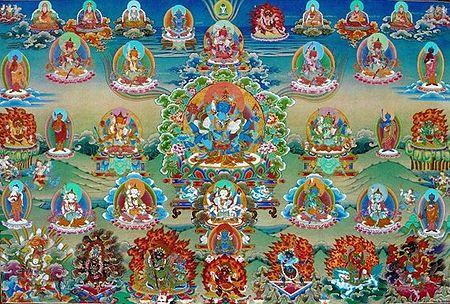
                         Hundred peaceful and wrathful deities of Tibetan Buddhism

What is Yidam practice?


Yidam (Tib. ཡི་དམ་, Wyl. yi dam; Skt. iṣṭadevatā) — one of the three roots, the tutelary or chosen meditation deity, which is the root of spiritual accomplishment. Yidams are often classified according to whether they appear in peaceful and wrathful form. 

Sogyal Rinpoche writes:

"In Tibetan Buddhism practitioners will have a yidam, that is, a practice of a particular buddha or deity with which they have a strong karmic connection, which for them is an embodiment of the truth, and which they invoke as the heart of their practice. Since in their practice they have recognized the yidam as the natural radiance of the enlightened mind, they are able to view the appearances with this recognition, and let them arise as the deity."

What is the importance of Yidam practice?

Orgyen Tobgyal Rinpoche explains the importance of the yidam:

When we consider all the great masters of the Indian and Tibetan traditions, we find that in every case, their accomplishment came about through their practice of a yidam. They chose a deity and guarded that practice like their very life force, and on the basis of that complete commitment to the path of deity yoga, they practised the stage of generation, the stage of completion, and integrated these arriving at their final realisation of complete accomplishment and enlightenment.

But nowadays there are people who say, “Oh, what a lot of bother! Deities and mantra, I hate all that. I’m just going to meditate.” And they sit there, and close their eyes, and that’s what they call practice. They say, “I just want to do effortless meditation.” But as Dilgo Khyentse Rinpoche said, “Although there are people like that, I’ve not seen them gaining any sign of attainment.”

In one of the texts of Ratna Lingpa’s cycle of Vajrakilaya practice, there is a passage which recounts how on one occasion Yeshe Tsogyal asked Guru Rinpoche about the nature of kyérim practice. “Do we really need a yidam deity?”, she questioned. Guru Rinpoche replied, “If there is no yidam, where is the source of siddhis? Without siddhi, how could there be enlightenment?”

In fact, if we look at the great masters of the Indian and Tibetan traditions of Vajrayana practice, we find there is no-one who did not meditate upon a yidam deity.

In the Nyingmapa school, all the great vidyadharas have had a main yidam deity which they practised. If their practice was of a peaceful deity, it was almost always Vajrasattva. If it was a wrathful deity, it was almost always Vajrakilaya. Guru Rinpoche and Vimalamitra themselves attested to the fact that Vajrakilaya was their yidam deity.

Nowadays however, the Nyingmapas are perhaps the worst when it comes to practising a yidam on a daily basis. When Jamyang Khyentse Chökyi Lodrö was giving the Rinchen Terdzö empowerment, he scolded us as Nyingmapa practitioners and said, “You Nyingmapas don’t do any kind of regular daily practice. You don’t even say the Sampa Lhundrupma prayer; you just lie around all day! We Sakyapas must do the path empowerment practice of Hevajra every day , which takes about two or three hours. You don’t do anything. You just lie around. You don’t do any kind of regular practice.”

He said to us, “If you want yidam deities, you Nyingmapas have more than anybody.” He showed us all the texts of the Rinchen Terdzö, which consists of dozens and dozens of volumes, and said, “This is filled with sadhanas of the three roots—lama, yidam and dakini—but none of you practises any of them.”

What he said was true. Perhaps the reason is that so many of us in the Nyingma tradition place great emphasis on the Dzogchen tradition and its effortlessness. Often we make the mistake of just paying lip service to effortlessness, while really just being kind of lazy.

Look at someone like Kyabje Dilgo Khyentse Rinpoche. No-one would question that his realisation was higher than anyone’s, and yet day and night he would recite prayers and mantras and do his practice. And he was inseparable from Vimalamitra! Look at the kind of effort that he put into his practice. Then there are others who just don’t do very much of that at all. They just sit there with their mouths open.

On one occasion, I asked Dilgo Khyentse Rinpoche, “Is it necessary for someone with realization to recite prayers and mantras?” And he replied, “Someone who has that kind of realisation is like space. What harm could recitation possibly do to space?” And he continued, “To recite even a single mani mantra, or to recite the Vajra Guru mantra a few times, is only going to help. It’s not going to hurt, is it?”

I couldn't agree more with what Orgyen Tobgyal Rinpoche has said here. He is absolutely right when he said that the great accomplishments of Indian and Tibetan masters came only from the worship of a pagan deity. A typical example is Ramakrishna Paramahamsa who was the teacher of Swami Vivekananda and all his accomplishments came only after he obtained the grace of goddess mother Kali. All the modern practitioners blinded by the stupid scientific attitude ignore the pagan gods and blindly go after knowing Brhaman and Nirvana and as you can see despite all their efforts for over a century or so they fail to produce a single mastery over nature or also called as siddhis. Why? its mainly because they follow the path of emptiness and they do not worship the pagan gods because for many westerners it is an embarrassment to worship pagan deities because it would undermine their stupid spiritual but not religious life.

No wonder why many of the extraordinary supernatural powers that can be performed by following eastern mystical practices are rarely demonstrated nowadays.

Eight primary siddhis

In Hinduism eight siddhis (Ashta Siddhi) are known:
  • Aṇimā: reducing one's body even to the size of an atom
  • Mahima: expanding one's body to an infinitely large size
  • Garima: becoming infinitely heavy
  • Laghima: becoming almost weightless
  • Prāpti: having unrestricted access to all places
  • Prākāmya: realizing whatever one desires
  • Iṣṭva: possessing absolute lordship
  • Vaśtva: the power to subjugate all

Bhagavata Purana

Five siddhis of yoga and meditation

In the Bhagavata Purana, the five siddhis of yoga and meditation are:
  1. tri-kāla-jñatvam: knowing the past, present and future
  2. advandvam: tolerance of heat, cold and other dualities
  3. para citta ādi abhijñatā: knowing the minds of others and so on
  4. agni arka ambu viṣa ādīnām pratiṣṭambhaḥ: checking the influence of fire, sun, water, poison, and so on
  5. aparājayah: remaining unconquered by others

Ten secondary siddhis

In the Bhagavata Purana, Lord Krishna describes the ten secondary siddhis as:
  • anūrmi-mattvam: Being undisturbed by hunger, thirst, and other bodily appetites
  • dūra-śravaṇa: Hearing things far away
  • dūra-darśanam: Seeing things far away
  • manaḥ-javah: Moving the body wherever thought goes (teleportation/astral projection)
  • kāma-rūpam: Assuming any form desired
  • para-kāya praveśanam: Entering the bodies of others
  • sva-chanda mṛtyuh: Dying when one desires
  • devānām saha krīḍā anudarśanam: Witnessing and participating in the pastimes of the gods
  • yathā sańkalpa saḿsiddhiḥ: Perfect accomplishment of one's determination
  • ājñā apratihatā gatiḥ: Orders or commands being unimpeded

Samkhya

In the Samkhya Karika and Tattva Samasa there are references to the attainment of eight siddhis by which one becomes free of the pain of ignorance, one gains knowledge, and experiences bliss. The eight siddhis hinted at by Kapila in the Tattvasamasa are as explained in verse 51 of Samkhyakarika:
  1. Uuha: based on the samskaras of previous births, the attainment of knowledge about the twenty-four Tatwas gained by examining the determinable and the indeterminable conscious and the non-conscious constituents of creation,
  2. Shabad: knowledge gained by associating with an enlightened person (Guru – upadesh),
  3. Addhyyan: knowledge gained through study of the Vedas and other standard ancillary texts,
  4. Suhritprapti: knowledge gained from a kind-hearted person, while engaged in the spread of knowledge
  5. Daan: knowledge gained regardless of one’s own needs while attending to the requirements of those engaged in the search of the highest truth,
  6. Aadhyaatmik dukkh-haan: freedom from pain, disappointment, etc. that may arise due to lack of spiritual, metaphysical, mystic knowledge and experience,
  7. Aadhibhautik dukkh-haan: freedom from pain etc. arising from possessing and being attached to various materialistic gains,
  8. Aadhidaivik dukkh-haan: freedom from pain etc. caused by fate or due to reliance on fate.

In Yidam practice one surrenders his individuality and attains oneness with the deity as explained below in Advice on Yidam practice.
“I am the great and glorious Heruka!
My food is the life-force of living beings,
My seat, the three worlds and three planes of existence.
I am the Lama. I am the Yidam.
I am Samantabhadra, the mighty Vajradhāra.
Without me, in the time before me,
There was no saṃsāra, no transcendence.
Now, the phenomena of saṃsāra and nirvāṇa
Are all perfect within me, the great Heruka.
The blazing fire mountain is my realm.
The vīras and ḍākinīs are my retinue.
The Great Perfection is my Dharma.
I am the Heruka of equalness and perfection.”
At all times, such pride is necessary.

By Shenphenpa (Khenpo Shenga).
Translated by Adam Pearcey, Rigpa Translations, 2013.

Theurgy

Theurgy (/ˈθiːɜrdʒi/; from Greek θεουργία) describes the practice of rituals, sometimes seen as magical in nature, performed with the intention of invoking the action or evoking the presence of one or more gods, especially with the goal of uniting with the divine, achieving henosis, and perfecting oneself.

The great divine Iamblichus, Proclus and Julian the Emperor gave a great deal of emphasis to theurgy in Neoplatonism which the academic scholars still see it with contempt eyes without understanding the supra-rational character of the art of theurgy.

Proclus (c. 480): theurgy is "a power higher than all human wisdom embracing the blessings of divination, the purifying powers of initiation and in a word all the operations of divine possession"
 Julian the Emperor said in his Hymn to King Helios that no one knows about the subject more better than the Neo-platonic philosopher the divine Iamblichus.

The Emperor Julian the Apostate (332-363), embraced Neoplatonic philosophy and worked to replace Christianity with a version of Neoplatonic paganism. Because of his death and the hold mainstream Christianity had over the empire at the time, this was ultimately unsuccessful, but he did produce several works of philosophy and theology, including a popular hymn to the sun. In his theology, Helios, the sun, was the ideal example of the perfection of the gods and light, a symbol of divine emanation. He also held the mother goddess Cybele in high esteem.

Julian favored ritual theurgy, with an emphasis on sacrifice and prayer. He was heavily influenced by the ideas of Iamblichus.
I want to fulfil the dream of Julian, his great desire to revive the pagan mystery religions back to the roman empire which for unfortunate reasons failed to succeed after his reign.

"By magical incantation rapid rivers may be made to run back to their fountains, the sea be congealed, winds become destitute of spirit, the sun be held back in his course, the moon be forced to scatter her foam, the stars be torn from their orbits, the day be taken away, and the night be detained."
- Iamblichus on the mysteries of Egyptians, Chaldeans and Assyrians.
"Theurgic union is attained only by the perfective operation of unspeakable acts correctly performed, acts which are beyond all understanding, and by the power of unutterable symbols which are intelligible only to the Gods"

Iamblichus, De Mysteriis. 2,11
Offering to the Gods: A Neo-platonic perspective by Edward P Butler is a fine study on the subject and demonstrates the wisdom and knowledge that the great divine Iamblichus had on the subject.

Conclusion

As the reader can see these set of pagan ideas are at the core of pagan philosophy and their attitude towards nature and religion. All the pagan religions have a certain affinity towards the art of theurgy and in eastern religions it was called by different names that's all but the theory and the practice remains absolutely identical. I urge scholars, practitioners and believers around the world to not to distort eastern mysticism and western esotericism and undermine the existence of pagan gods and their culture and philosophy.

Tuesday, 15 July 2014

Who is the first born of all creation? Christ? or the Sun God?

Saint Paul always upsets me when he said this in his letters,
Colossians 1:15 He(Christ) is the image of the invisible God, the firstborn of all creation. 16 For by Him all things were created, both in the heavens and on earth, visible and invisible, whether thrones or dominions or rulers or authorities-- all things have been created through Him and for Him.…
I was upset because in the Rig Veda it says it is the Sun God, Hiranyagarbha which is the first-born of all creation. 
Rig Veda (10.121) 1 In the beginning rose Hiranyagarbha, born Only Lord of all created beings.He fixed and holdeth up this earth and heaven. What God shall we adore with our oblation? (Translated by Griffith)
So how can there be two deities at the beginning of creation and each one claiming to be the first-born over all creation? Now any non-believer will say that this is not surprising at all as Saint Paul took a lot of his themes from the pagan mystery religions. To me, that's like undermining Christianity even before addressing the real problem and such a view should not be tolerated and encouraged at all because these morons are ignorant of one aspect of Saint Paul that he had a genuine apostolic Christian tradition behind him named Valentinianism who claimed to have had authentic esoteric interpretation of Pauline Letters and a continuity of genuine apostolic tradition. As Einar Thomassen says Valentinians were the great Paulinists and we will not let anyone criticize our most revered Saint so easily and get away just like that.

Isn't it a irony that the person whom the orthodox Church quotes to fight against the Gnostics and the Gnostic ideas is in fact the person whom the Gnostics claim to be their sole initiator into the mysteries of gnosis. Both atheists and orthodox Christians have underestimated Saint Paul and the gnosis of the Valentinian Christians and they are going to pay for it big time.

So who is the first born of all creation? Christ? or the Sun God? The reasonable explanation will be that unity appeared as Christ to Christians and at the same time the same unity appeared as Sun God to Vedic Aryans. Well this is a typical pagan attitude isn't it showing tolerance and pluralism towards religions of other nations and their deities. Yes for I am a pagan first and then a Christian. Also I know what its like to have gnostic visionary experiences and it is absolutely arrogant and foolish to assume that only we had genuine experiences and think that the divine revealed itself only to us and not to the people of other nations especially when both of our visions are explaining the same reality word to word having differences only in our linguistic description of the divine. 

2nd century Gnostic Christians shouldn't be indebted to Greeks, Neoplatonists, the Persians or the Aryans because the knowledge of the divine is no one's intellectual property and I hope Plotinus and anyone who thinks like that understands it clearly. Any philosopher who expects credit in the matters of the divine and shouts at others for plagiarising his teaching is not a true philosopher and he doesn't really know anything about the divine. If the Vedic rishis had copyrighted all their teachings then every Greek, Egyptian and Persian philosopher and theologian would have nothing to boast about.